Anesthesia Charge Capture

Everything you need to know about Anesthesia Billing & Coding Services

Talk To An Expert

Your guide to mastering anesthesia billing accuracy, compliance, and automation with medaptus Charge Pro.

Navigating the complexities of anesthesia billing & coding services can feel overwhelming. Every minute counts, every modifier matters, and even small documentation errors can create ripple effects across a hospital’s revenue cycle.

At medaptus, we understand how detailed and error-prone coding anesthesia can be. Our anesthesia coding software was designed to automate anesthesia information across perioperative and billing systems—reducing manual steps, minimizing compliance risk, and helping providers and coders focus on what truly matters: delivering excellent care while ensuring accurate, timely reimbursement.

This guide breaks down everything you need to know about optimizing anesthesia billing, from key components and coding rules to common challenges and best practices. You’ll also learn how Charge Pro—the leading anesthesia billing software and reconciliation platform—automates anesthesia workflows to improve accuracy and accelerate cash flow.


1. Key Components of Anesthesia Billing

Anesthesia billing is unlike any other area of medical billing. It involves precise time tracking, procedure-specific CPT codes, and a range of modifiers that reflect patient condition, concurrency, and supervision rules.

The Core Elements:
Base Units – Assigned to anesthesia procedures based on complexity.
Time Units – Calculated from when anesthesia care begins to when the provider is no longer responsible for the patient. Typically, every 15 minutes equals one time unit.
Physical Status Modifiers – Reflect the patient’s health condition and influence reimbursement.
Concurrency Rules – CMS regulations limit anesthesiologist supervision to four simultaneous cases.

Every anesthesia encounter carries significant revenue potential. Missed or mistimed entries can result in serious revenue leakage. As Gary Bernklow, Senior Product Director at medaptus noted:

“Anesthesia was always its own thing because it’s super complex—and huge revenue. It deserves its own focus and automation.”

2. Understanding Anesthesia Billing Codes

Accurate coding anesthesia begins with CPT and ICD-10 codes combined with the proper modifiers.

How Codes Work Together:
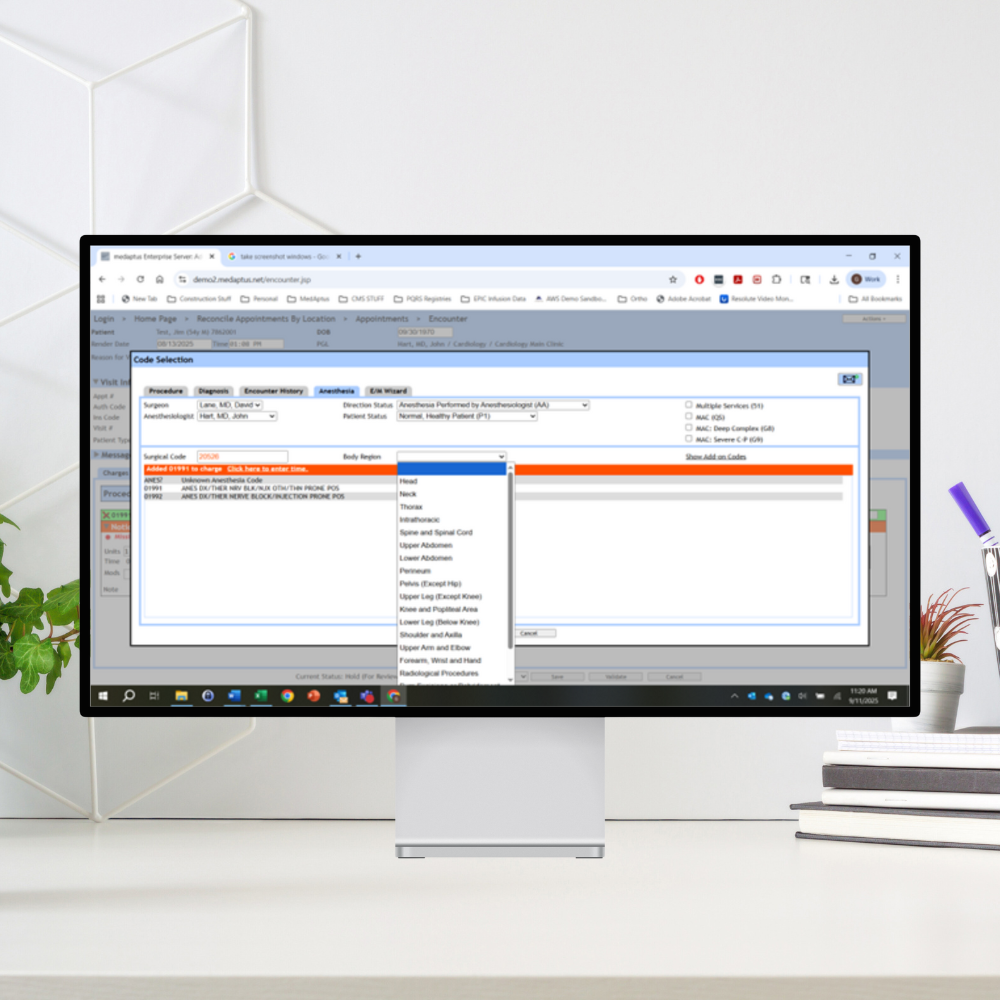
Surgical CPT → Anesthesia CPT Mapping – Each surgical procedure has a specific set of anesthesia codes. Charge Pro, a powerful medical billing software for anesthesia, automatically narrows the options based on documented procedure and diagnosis.
Modifiers – Indicators for physical status, provider type, concurrency, and supervision—applied automatically through checkboxes.
Professional vs. Facility Billing – Professional anesthesia services are billed separately from the drugs, supplies, and equipment handled through the facility’s billing system.

Charge Pro integrates directly with Epic and Cerner, pulling surgical and diagnosis data to automate anesthesia information, prepopulate anesthesia CPTs, and apply modifiers automatically—reducing errors and ensuring compliance.

3. Common Challenges in Anesthesia Billing

Manual anesthesia billing & coding services face recurring challenges:

• Manual time entry → inaccurate billing and missed units.
• Modifier complexity → higher risk of denials.
• Concurrency errors → CMS compliance issues.
• Missing data feeds → unbilled encounters.
• Limited EHR integration → spreadsheet or paper tracking.

As Bernklow explained, many hospitals still depend on manual or disconnected workflows. Charge Pro—a leading anesthesia medical billing software—automates perioperative data capture, removing barriers and improving throughput.

4. Best Practices for Efficient Billing Operations

1. Document start and stop times precisely.
2. Track concurrency automatically with built-in logic.
3. Integrate EHR data directly to eliminate duplicate entry.
4. Automate ASA modifier application to reduce denials.
5. Use Quick Charge for anesthesiologists working at multiple hospitals without data feeds.

These practices help organizations achieve complete, compliant billing and lay the groundwork for optimizing anesthesia billing performance.

5. Enhancing Financial Outcomes with Automation

Charge Pro transforms anesthesia charge capture into a fully automated mid-revenue-cycle workflow:

• Automated reconciliation → every billable case captured.
• Compliance rules → modifiers and concurrency handled automatically.
• Dashboards → real-time visibility into missing or delayed charges.
• Integration → Epic/Cerner go-live in as little as 90 days.
• ROI → measurable improvements in anesthesia billing accuracy and cash flow.

Hospitals using Charge Pro can extend automation to anesthesia billing workflows—leveraging existing integrations and infrastructure to reduce errors and speed reimbursements.

Why medaptus?

For over two decades, medaptus has helped hospitals and physician groups optimize mid-revenue-cycle performance. With Charge Pro, anesthesia billing becomes faster, more accurate, and fully compliant.

From capturing start/stop times to managing concurrency and ASA modifiers, Charge Pro’s anesthesia billing software ensures every anesthesia service is billed correctly—allowing teams to focus on patient care rather than paperwork.

Ready to close your anesthesia revenue gap?

Book A Demo

Get the latest updates and news delivered to your inbox.

Subscribe to our newsletter today.