

Blog Summary
Anesthesia coding is uniquely complex because it relies on time-based billing (Total Units = Base Units + Time Units + Modifiers), requires ASA-to-CPT crosswalk lookups, and involves concurrency rules that differ between CMS and commercial payers. Manual anesthesia coding takes 5–7 minutes per case and is prone to modifier errors that trigger denials or audits. medaptus automates the entire workflow — CPT-ASA mapping, time tracking, modifier application, and compliance checking — integrating directly with the EHR to minimize manual entry and accelerate the revenue cycle for anesthesia departments.
In the world of healthcare billing, few areas are as complex or as overlooked as anesthesia coding. Between ASA crosswalks, concurrency rules, time tracking, and compliance modifiers, it’s no surprise that many organizations face delays, errors, and revenue leakage.
But what if much of that could be automated?
At a time when margins are tightening and every claim matters, hospitals and health systems are turning to automated anesthesia coding to transform how they capture charges, reduce manual effort, speed up workflows, and safeguard compliance.
Why Is Anesthesia Coding a Hidden Revenue Bottleneck?
What Makes Anesthesia Coding More Complex Than Other Specialties?
Anesthesia coding has four layers of complexity that distinguish it from most other billing scenarios:
1. ASA Crosswalks: Coders must use ASA’s CPT crosswalk to map surgical codes to appropriate anesthesia codes.
2. Concurrency Rules: When an anesthesiologist supervises multiple procedures concurrently, specific concurrency rules apply—these rules differ significantly between payers, particularly between CMS and commercial insurers. Coders must consider overlaps and staffing roles (e.g., CRNA vs. MD).
3. Time-Based Billing: Unlike most other specialties that bill by procedure or diagnosis, anesthesia uses time units (typically 15-minute increments) combined with base units assigned by ASA (American Society of Anesthesiologists). Mistakes in tracking or rounding time can significantly impact reimbursement which makes anesthesia start and stop time documentation so important.
You must calculate:
Total Units = Base Units + Time Units + Modifiers
4. Modifiers and Roles: Correct application of modifiers (AA, QK, QX, QZ, etc.) is essential. These reflect who performed or supervised the procedure and have direct billing consequences. Incorrect modifier use can trigger denials or audits.
What Is Slowing Down Anesthesia Coding Workflows Today?
For most anesthesia departments, delays come from a familiar set of culprits:
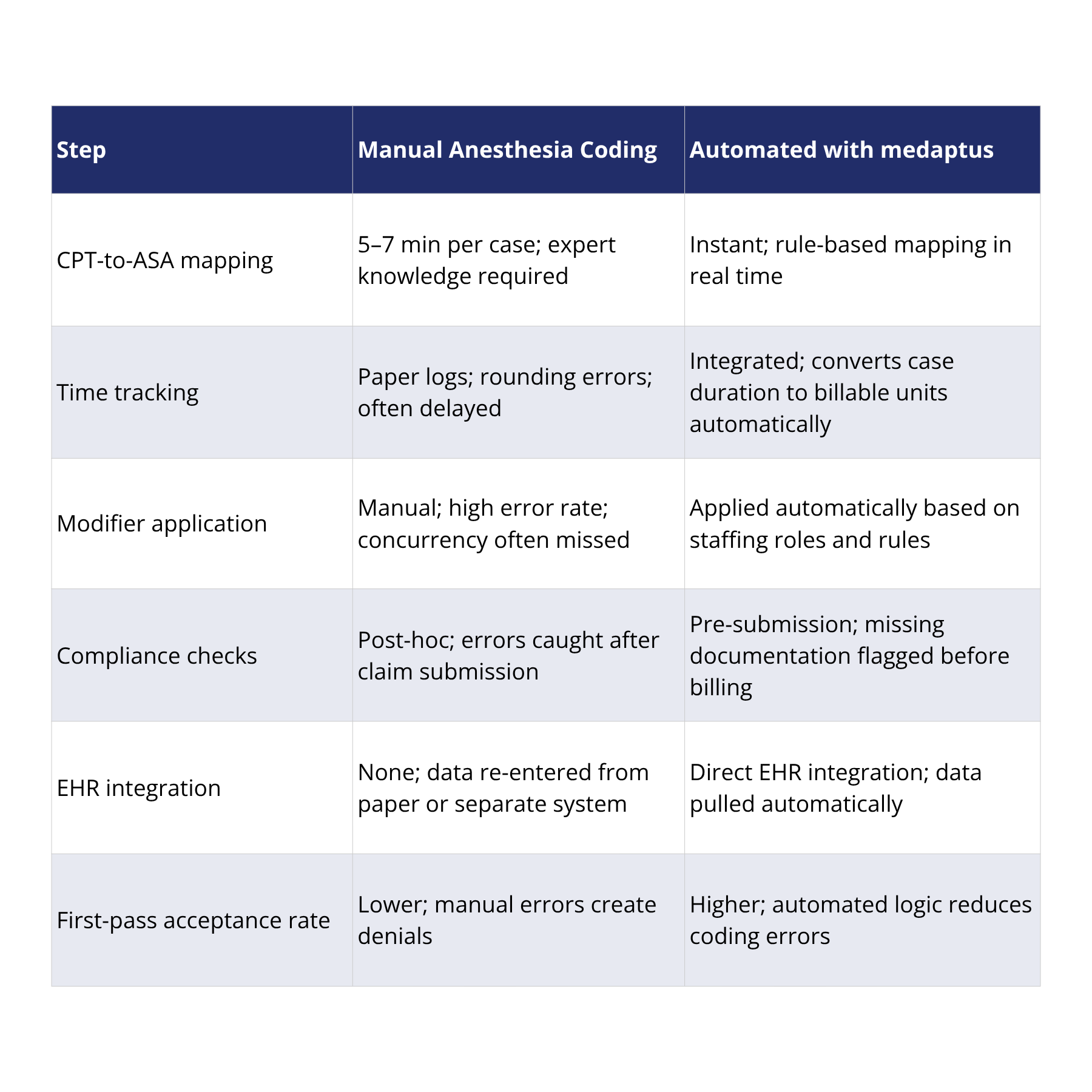
- Manual CPT-to-ASA mapping: Translating surgical procedure codes into anesthesia billing codes takes expert knowledge and time (often 5–7 minutes per case).
- Paper-based time logs: Inaccurate or delayed recording of anesthesia duration directly impacts reimbursement.
- High dependency on expert coders: Few staff have deep knowledge of ASA rules, so coding backlogs are common.
- Post-hoc compliance checks: Errors such as missing modifiers or unbundled services are caught too late, delaying payment and increasing denial risk.
These challenges increase the administrative burden and put hospitals at risk of under-coding, non-compliance, and avoidable write-offs.
Table 1: Manual vs. Automated Anesthesia Coding
How Does the medaptus Anesthesia Coding Automation Platform Work?
Medaptus was founded over 20 years ago to address inefficiencies in hospital charge capture. More than 15 years ago, the company expanded that expertise to anesthesia with a specially designed, intelligent charging solution.
Our anesthesia coding automation platform:
- Assigns accurate procedure codes based on surgical CPTs
- Tracks concurrency and applies appropriate modifiers automatically
- Calculates correct billing units based on anesthesia duration
- Flags incomplete documentation for follow-up, ensuring compliance
Today, Medaptus integrates directly with your EHR, extracting relevant anesthesia data automatically and minimizing manual charge entry.
Conclusion
Anesthesia billing doesn’t have to be a bottleneck. With the right automation tools, organizations can streamline their workflows, reduce reliance on manual labor, and ensure they’re getting paid fully and compliantly for the care they deliver.
Is your anesthesia department still relying on manual coding? It might be time to automate and accelerate. Book a demo here.
FAQs
Why Is Anesthesia Coding Different from Other Medical Billing?
Anesthesia is one of the few specialties that uses time-based billing rather than procedure-based billing. Reimbursement is calculated using a formula of Base Units + Time Units + Modifiers, making accurate time documentation and correct modifier application critical. This complexity, combined with ASA crosswalk requirements and concurrency rules, makes anesthesia one of the most error-prone billing areas in healthcare.
What Are the Most Common Anesthesia Coding Errors?
The most common errors include incorrect CPT-to-ASA code mapping, inaccurate time unit calculation (especially rounding errors near 15-minute thresholds), missing or incorrect modifiers (AA, QK, QX, QZ), and failure to account for concurrency rules when an anesthesiologist supervises multiple concurrent procedures.
How Does medaptus Handle Anesthesia Concurrency Rules?
Medaptus’ rules engine tracks staffing roles — distinguishing between CRNA and MD supervision, solo vs. concurrent cases — and automatically applies the correct concurrency modifiers based on payer-specific rules (CMS vs. commercial). This eliminates the need for coders to manually assess each case’s supervision scenario.
What EHRs Does medaptus Anesthesia Coding Integrate With?
Medaptus integrates directly with major EHR systems used in anesthesia departments, including Epic, Cerner, Meditech, and others. The integration pulls scheduling and case data automatically, minimizing manual entry and ensuring accurate, timely charge capture.

About The Author
Mallory Denomy is a Business Development Manager at medaptus with a background in hospital-based social work. She specializes in infusion billing, revenue cycle operations, and customer relationships.
Get the latest updates and news delivered to your inbox.
Subscribe to our newsletter today.