

Blog Summary
A hospital medicine operations software buying committee gets the most out of a vendor evaluation when each stakeholder asks the question that matches their job function instead of everyone circling the same integration question. Healthcare IT purchases typically involve stakeholders across multiple departments, so the strongest evaluations assign specific ownership. IT verifies the EHR integration timeline and feed types, the clinical champion tests real adoption and workflow fit, finance builds the payback case, and compliance confirms data handling and security practices. When asking these questions, the clearest signal of vendor quality is how they describe handling a bad week for an existing customer and whether references from similarly sized programs back that up.
I’ve noticed the room gets bigger every year. A hospital medicine operations software evaluation used to be a conversation between the program director and maybe someone from IT. Now there’s usually a clinical champion in the room, someone from finance who wants to see the numbers we talked through last week, someone from compliance asking about data handling, and often the CIO’s office weighing in on integration before anyone signs anything. That’s not a bad thing. It just means the questions each person brings to the table matter more than they used to, because a vendor who answers the IT question well but dodges the clinical one is going to cause a real problem six months into the contract.
This blog is written for people sitting on one of these committees comparing vendors. I’m not going to tell you which vendor to pick. I’m going to tell you what to ask and what the answer indicates.
Who Needs to Be in the Room When You Evaluate Hospital Medicine Software?
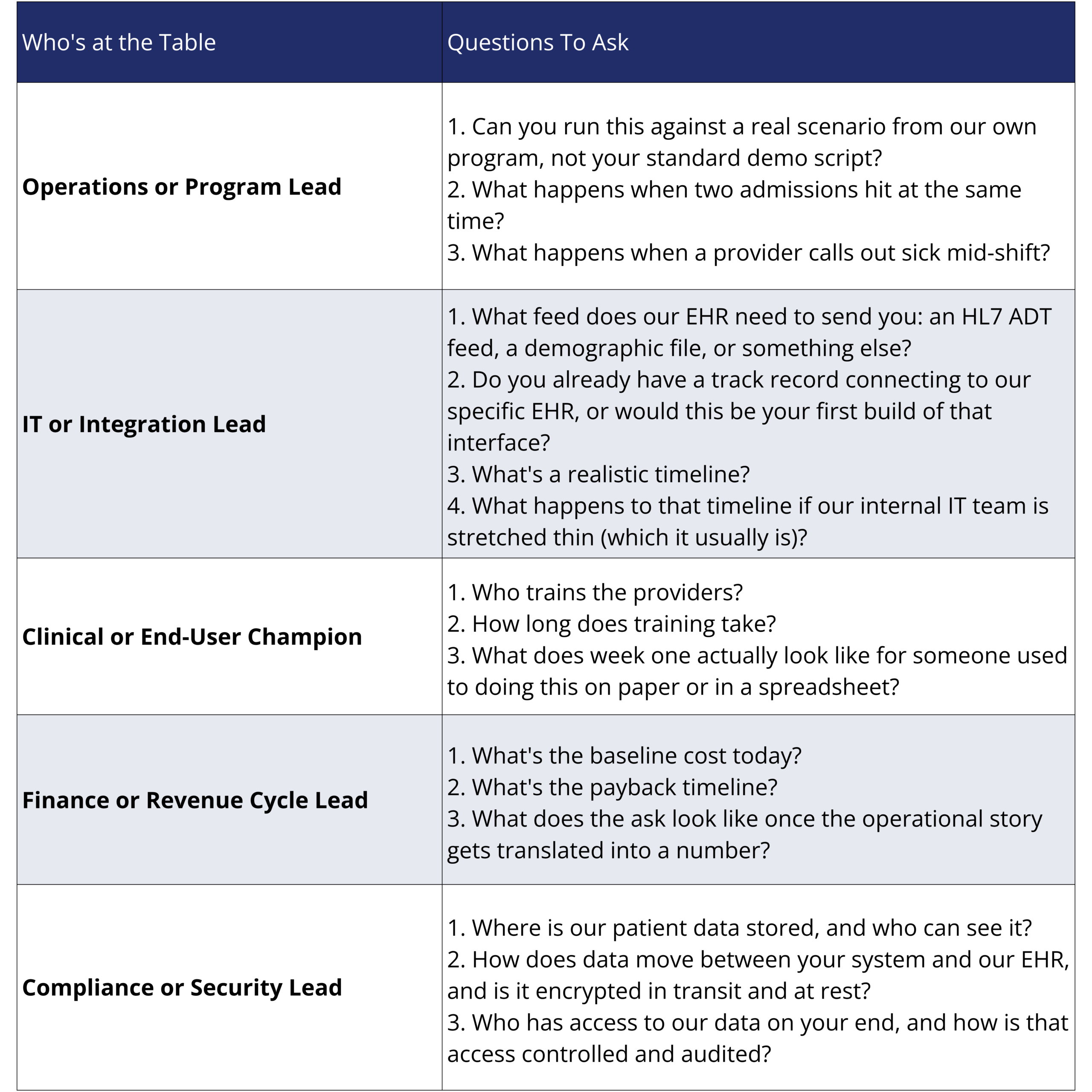
Research from Forrester’s The State of Business Buying Report found that nearly 89% of B2B buying decisions now cross multiple departments, which tracks with what I’ve seen. Hospital medicine operations software touches intake, assignment, distribution, reconciliation, and analytics, so it’s rarely just one department’s call. I view that as a good thing because the trick is making sure each person at that table is asking the right questions that match their job function. This prevents five people from asking versions of the same integration question while nobody asks about support after go-live.
What Should Each Person at the Table Be Asking?
How Do You Tell a Vendor Who Can Deliver From One That’s Just Selling?
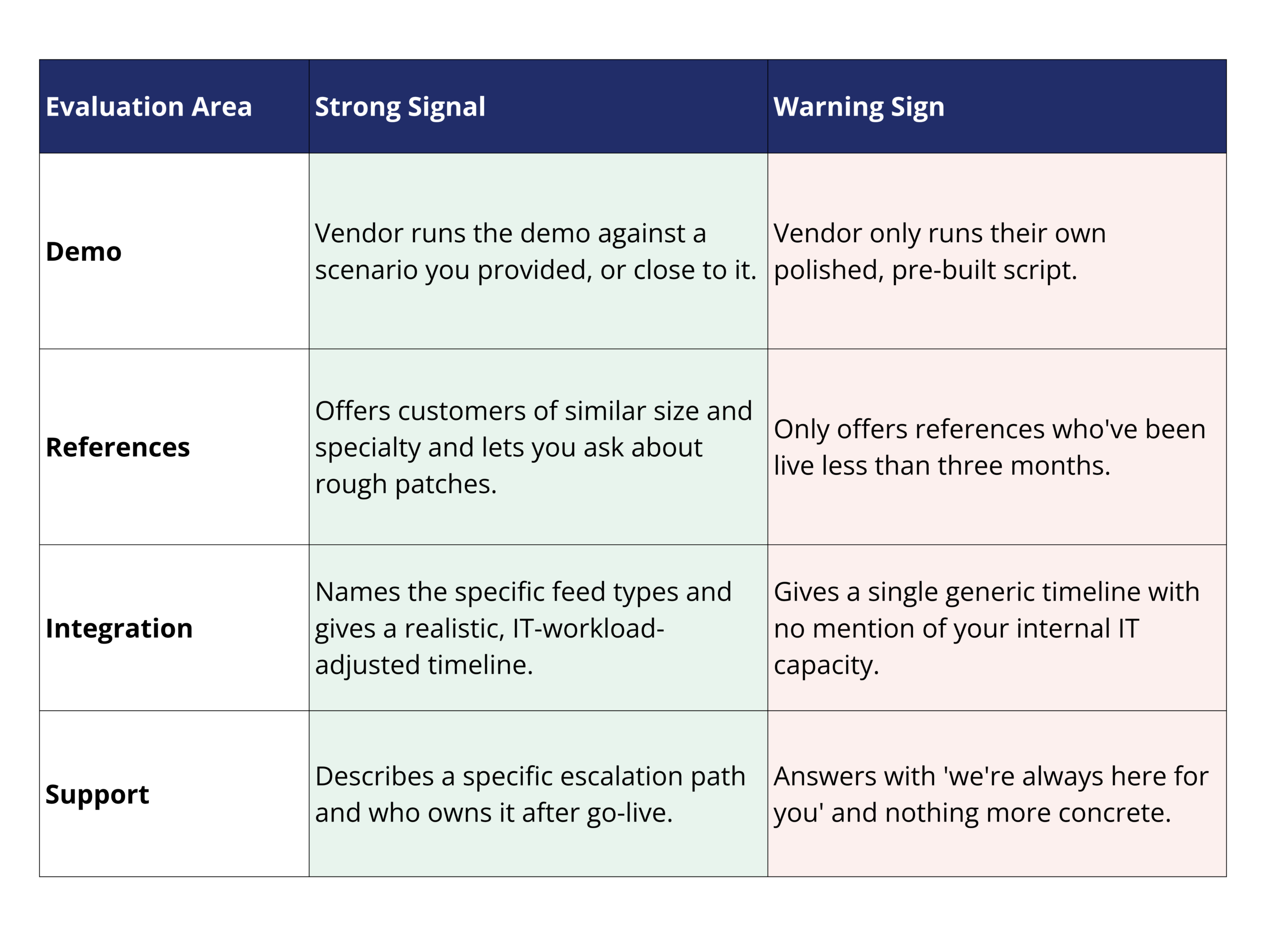
This is where I’d tell you to trust what you can verify over what you’re told. Ask for references from programs similar in size and complexity to yours, not just the vendor’s best customer. Ask what a bad week looks like for an existing customer and how support responded. Every piece of software has a bad week eventually, and the response by the customer team is the actual product.
Conclusion
The buying committees that end up happy with their decision a year later aren’t the ones with the longest feature checklist. They’re the ones where every person at the table asked the question that matched their job function and pushed past the rehearsed answer until they got a real one.
Medaptus Command was built to hold up under exactly this kind of scrutiny. We want to answer the hard integration and adoption questions during evaluation so you can feel confident going forward.
FAQs
How many people should actually be involved in evaluating hospital medicine operations software?
Enough to cover operations, IT, clinical workflow, finance, and compliance, typically somewhere in the range of five to eight people for a program of meaningful size. Fewer than that and you risk missing a blind spot; a lot more than that, and decisions tend to stall without getting any better.
What’s the single question that tells you the most about a vendor?
Asking what a bad week looks like for one of their existing customers, and how support handled it. Every vendor can describe their best case. How they talk about the worst case tells you much more.
Should IT or clinical leadership drive the evaluation?
Neither. The programs that end up satisfied usually have operations leadership driving the process with IT and clinical stakeholders as equal partners in the questions, not one group running point while the others sign off at the end.
How long should a proper vendor evaluation take?
Long enough to get real references, a demo against your own scenarios, and a specific integration timeline from IT. This usually takes more than a few weeks but doesn’t need to stretch past a couple of months if the committee is organized.
What’s a red flag during a vendor demo?
A vendor who can only run their own pre-built script and can’t adapt the demo when you describe a scenario from your own program. That usually means the flexibility isn’t really there once you’re live.

About The Author
Jaclyn Corbett is the Product Manager for medaptus Command and Assign, with over 13 years working at the intersection of healthcare operations and software development. She works directly with hospital medicine programs to understand how operational workflows break down and how technology can reconnect them.
Get the latest updates and news delivered to your inbox.
Subscribe to our newsletter today.