

Blog Summary
A medical necessity denial occurs when the diagnosis submitted on a claim does not support the procedure billed, meaning the clinical reason for the visit does not justify the service charged. Within medical necessity denials specifically, diagnosis code degradation is one addressable cause: a physician documents a precise, clinically supported code in the EHR, and that code is modified to a less specific alternative during the billing process. Coders typically improve claim accuracy rather than diminish it, but when it does occur it rarely gets audited because it runs counter to the standard assumption that coder involvement strengthens a claim.
Denial management is not a single-solution problem. Claims are denied for a wide range of reasons: a patient’s insurance lapsed, a procedure was not prior-authorized, a provider was not credentialed with a particular payer, or a coverage rule changed without the billing team’s knowledge. Each driver may require a different workflow fix.
This article focuses on one specific aspect of medical necessity denials that is often overlooked because it originates inside the billing process itself, not in clinical documentation or payer policy. When a physician documents a precise diagnosis code in the EHR, that code should arrive at the payer unchanged. In some organizations, it does not.
Revenue cycle leaders who trace this pattern often find not a documentation problem but a fidelity problem. The provider’s code was changed somewhere in the workflow. A biller or coder modified it, typically with good intentions, and the modification may have degraded a specific code into an unspecified one or changed it completely. The payer’s system flagged the unsupported code, and the claim was denied. Understanding how this happens, and how to prevent it, is one component of a broader denial reduction strategy.
Why Is Your Claim Telling a Different Story Than Your Chart?
In most organizations, coders are more accurate than providers at selecting diagnosis and CPT codes. Most providers rely on the coding team to catch errors and prevent medical necessity denials, and that reliance is generally well-placed. I was recently talking to a physician leader who had a unique problem: a precise, clinically supported physician code was often being replaced by a less specific alternative during the billing process. Since this is something that does not typically happen, it’s not something administrators audit. It contradicts the standing assumption that coder involvement improves the claim. When no one expects it to break the other way, no one is looking for the cases where it does.
In organizations that rely on manual re-entry or route charges through a billing system separate from the EHR, that flow breaking down is serious. A coder reviewing the charge may see that code and decide, for any number of reasons, that it should be changed. Perhaps their history with this provider shows that the documented code is often incorrect. Perhaps they are unfamiliar with the condition and default to an unspecified alternative. Perhaps they are following a workflow habit that predates the organization’s current documentation practices for that specific condition
An RCM director at a large multi-site physician group described this problem directly after reviewing her organization’s denial patterns: “When I look at the chart and what they have actually documented in the medical record, it is beautiful. It is very specific. And what I see coming across [the billing system] isn’t great.” Her response was to establish a firm policy for her team: “I do not want you to change any of the physician’s diagnosis coding.”
The solution is correct, even if the instinct to second guess the coder is not typical. The challenge is enforcement. A policy communicated in a staff meeting does not prevent a coder from making a change in the system. The only reliable way to protect provider-entered diagnosis codes from this specific source of degradation is to build that protection into the charge capture workflow itself.
Payers have also raised the stakes with many now deploying automated systems to perform the first review of submitted claims specifically for diagnosis “exclude” pairs or to flag unspecified codes when a more specific code exists. Claims that passed review in previous years are increasingly being denied on the first automated sweep.
How Does Charge Pro Validate Diagnosis Codes at the Point of Entry?
Medaptus’ Charge Pro software addresses the fidelity problem through two mechanisms: eliminating re-entry risk and running every charge through a multi-layer rules engine before it reaches billing.
By integrating directly with your EHR, Charge Pro pulls charge data including provider-entered diagnosis codes directly from the source. Providers do not re-enter their codes into a secondary system. The code is captured at the point of documentation and moves through the Charge Pro workflow without being subject to re-keying or substitution before review.
Once captured, every charge is validated in real time through three distinct layers:
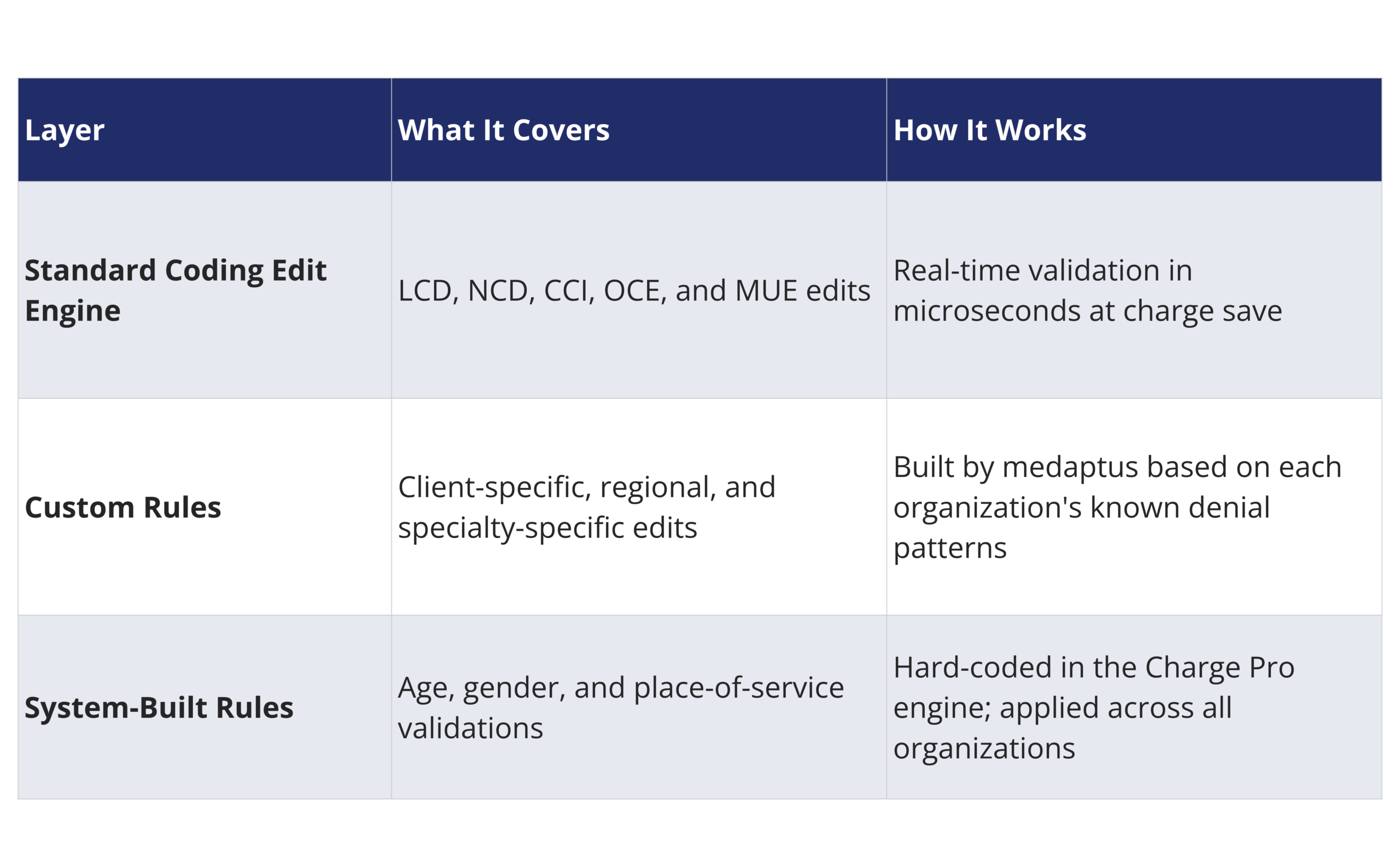
Our Standard Coding Edit Engine layer handles standard CMS edits, including Local Coverage Determinations (LCDs), National Coverage Determinations (NCDs), Correct Coding Initiative (CCI) edits, Outpatient Code Editor (OCE) edits, and Medically Unlikely Edits (MUEs). When this engine identifies a coding issue, the charge is placed on hold and the coder is notified in the system. The validation occurs in microseconds, at the moment the charge is entered or updated.
The custom rules layer addresses anything outside the standard set: regional payer-specific billing requirements, specialty-specific coding nuances, and denial patterns unique to a particular organization. When a group identifies a recurring denial type, that pattern can be encoded as a custom rule so future charges with the same issue are caught before submission.
The system-built rules layer handles validations that are broadly applicable but fall outside the Standard Coding Edit Engine’s standard evaluation set, including age-based procedures, gender-specific diagnoses, and place-of-service checks that vary by specialty.
When a Code Is Changed, How Does the Audit Trail Work?
Even in organizations with strong documentation practices, there are legitimate reasons a coder may need to modify a provider-entered code. Documentation may not support the level of specificity the provider selected. A payer-specific requirement may necessitate an adjustment. Charge Pro accommodates those situations, but it requires accountability.
When a coder modifies or deletes a provider-entered diagnosis code or CPT code in Charge Pro, the system requires a documented reason before the change is saved. Organizations configure a dropdown of common reasons, covering scenarios like specificity gaps, payer requirements, or clear data entry corrections, along with a free-text field for anything outside that list. Every change is logged with the coder’s identity, the timestamp, the original code, the modified code, and the stated reason.
For a revenue cycle management director managing coding behavior across a large billing team, this audit trail is the mechanism that makes a policy actionable. It identifies which codes are being changed, by whom, how often, and for what stated reason. When a pattern emerges across multiple coders, it may indicate a training gap. When a single coder consistently modifies the same code type, that is a focused coaching conversation supported by data, not an anecdote.
Conclusion
The cleanest data in the revenue cycle may be in the physician’s own note. The diagnosis a provider enters in the EHR reflects their clinical judgment and their documentation of the patient’s condition. Getting that code to the payer without modification may not always be a preference. As payers tighten automated scrutiny of unspecified codes and excluded diagnosis combinations, it is one more reason to examine where in the workflow those codes are being changed, and to build controls to assure accuracy is maintained. Charge Pro’s direct EHR integration, three-layer rules engine, and code-change audit trail are designed to protect diagnosis integrity from both the physician documentation and the coders expertise, and to surface workflow problems when exceptions occur.
Click here to read the sister article about how exception-based charge capture decreases denials.
FAQs
What is a diagnosis code fidelity problem?
A diagnosis code fidelity problem occurs when the code that reaches the payer differs from the code the physician originally documented. This can result from manual re-entry into secondary billing systems, coder modifications, or workflow steps that allow changes without documentation. The result is frequently a medical necessity denial tied not to poor documentation but to a code that was altered after the physician entered it. It is one of several causes of medical necessity denials and one that can be addressed directly through charge capture workflow controls.
How does Charge Pro prevent unauthorized diagnosis code changes?
Charge Pro pulls charge data, including diagnosis codes, directly from your EHR, which eliminates manual re-entry. When a coder does modify a provider-entered code, the system requires a documented reason before the change is saved. That reason is logged with the coder’s identity, the timestamp, and both the original and modified codes, creating a complete audit trail.
What is the Standard Rules Edit Engine, and how quickly does it work?
The Standard Rules Edit Engine is the coding scrubber that medaptus contracts for real-time charge validation. When a charge is entered or updated in Charge Pro, the system sends the charge data to the engine and receives a response in microseconds. The edit engine evaluates the charge against standard CMS edits including LCDs, NCDs, CCI edits, OCE edits, and MUEs, and returns any coding issues as hold notifications in the Charge Pro interface.
What are excludes-1 and excludes-2 denials?
Excludes-1 and excludes-2 are CMS designations for diagnosis codes that should not be billed together. Historically, payers largely ignored these combinations in claim review. That is changing, as payers increasingly use automated systems that flag and reject claims containing these conflicting code pairs. This is just one of the ways medaptus incorporates updates automatically into the Charge Pro rules engine so these conflicts are identified at charge entry rather than at the payer’s first automated review.

About The Author
Gary Bernklow is the Director of Product Management at medaptus, where he has spent nearly two decades shaping the company’s revenue cycle software solutions. With over 30 years of experience in hospital revenue cycle management, Gary brings deep expertise in charge capture, coding automation, and billing workflows.
Get the latest updates and news delivered to your inbox.
Subscribe to our newsletter today.