

Blog Summary
EHRs like Epic and Cerner were not built as charge capture tools. While they offer basic charge entry functionality, they lack real-time reconciliation dashboards, automated missing-charge identification, mobile rounding tools, and a built-in charge validation rules engine. Without these capabilities, organizations miss charges, experience delayed billing, and face manual processes that slow throughput. Medaptus Charge Pro fills this gap — integrating between your EHR and billing software to identify missing charges in real time, apply compliance rules automatically, and accelerate charge throughput.
It’s quite common for a hospital or large healthcare organization to utilize a powerful EHR like Cerner or Epic for not just their patient documentation and health records, but also as a charge capture tool. In fact, the main reason that organizations move from paper to electronic charge capture is precisely for the benefits of being able to identify missing charges, see charges and updates in real-time, report on that information and communicate it back to providers.
But while EHRs often have basic functionality for charge capture, they may be missing important charge capture and reconciliation features that is leaving revenue on the table. After all, EHRs weren’t built to be charge capture tools – and while they have some functionality to piecemeal it, it’s not enough to help you understand the full scope of all your charges and what could be missing.
That’s why healthcare organizations choose medaptus to be the missing link between their EHR and billing software.
Why Is Your EHR Leaving Charges on the Table?
How Does Charge Reconciliation Work in an EHR Like Cerner — and Where Does It Fall Short?
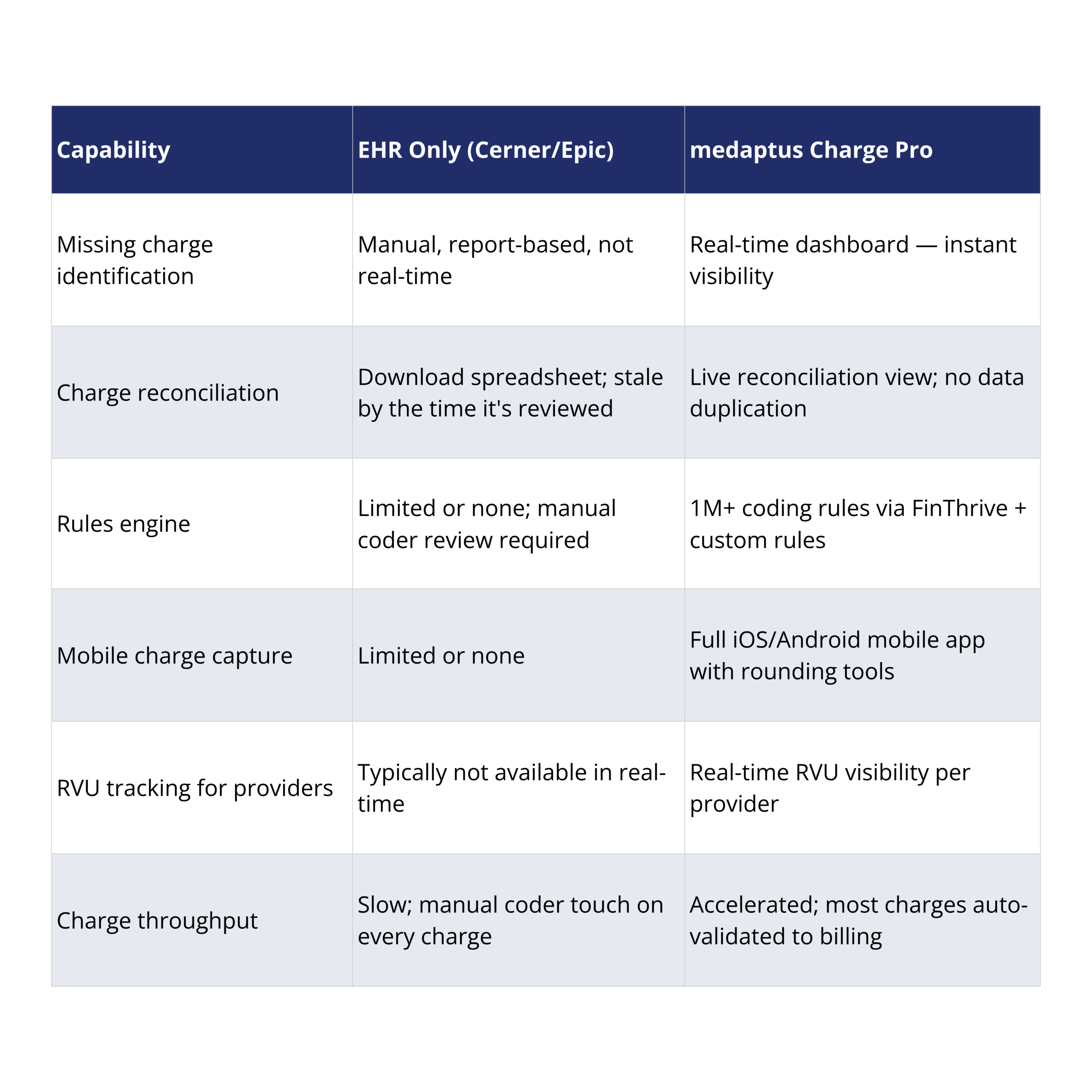
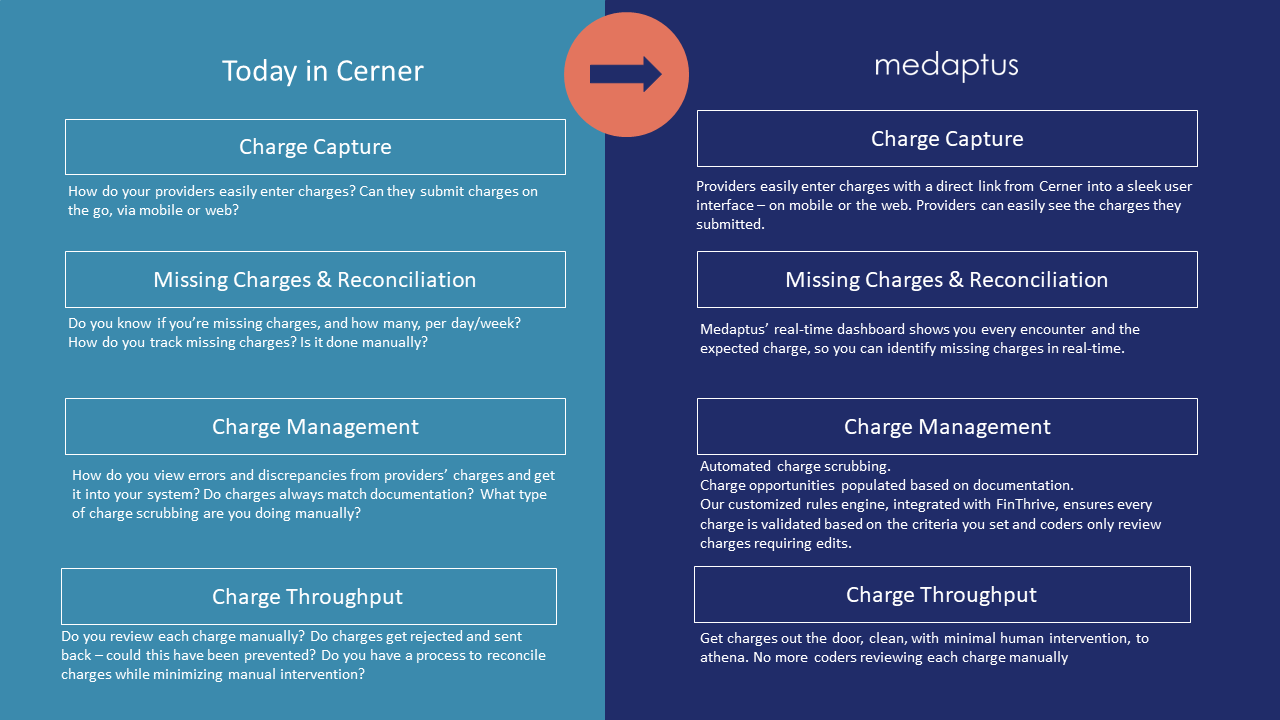
Does your Cerner EHR make it easy for you to identify missing charge opportunities and reconcile missing charges, especially on the inpatient side? If you can identify missing charges in Cerner, is the information updated in real-time or do you have to download a report and then track down those charges, at which point that information is out-of-date anyways?
What we commonly see with using Cerner for charge capture is that a provider will see a patient and document it in Cerner. They can then submit their CPT and diagnosis codes for that encounter.
But once it’s submitted, there’s no back-end dashboard that coders or reconcilers can go in and review the charges that were submitted in real-time; or identify if a provider missed a patient and is missing a charge.
Medaptus’ Charge Pro software makes this simple. You can easily view missing charges, scrub those charges and get them to billing faster – with a real-time dashboard. Integrated with your Cerner EHR, you’re not inputting any data twice – but now you have a connecting tool between Cerner and your billing software to identify missing charges.
Not sure if you can do this today? Here are some questions to ask your team to get started:
- How will you identify situations where there are missing charges? What would your process look like?
- How can you ensure every patient encounter has a charge and is not missing a charge? What does that look like in Cerner vs. Medaptus?
- How do providers communicate they’re missing a charge or how do you communicate back to a provider they’re missing a charge? Is this manual?
- How do you reconcile a charge in real-time?
- How will you report on things like E&M distribution or charge lag? Is the data easily accessible to you?
- What is the labor cost for you to have to review all encounters and identify missing charges manually?
Why Is Real-Time Charge Information Critical?
Let’s say that your experience is that Cerner is enough for charge capture – well, what about the fact that you’re missing out on getting charge information in real-time?
In Cerner, your providers enter charges. Then, Cerner can provide reports and spreadsheets that you could download to make sure you’re not missing charges. When you pull those reports, they’re only active the time you pulled it – not in real-time which makes it hard to properly reconcile as you may be chasing down information that may already be submitted after you downloaded the report.
For example, imagine Dr. Davida sees three patients and submits one charge. You pull a Cerner report today and chase Dr. Davida for two missing charges. But what if she submits them a few hours after you pull the report?
How Does Provider Experience Affect Charge Submission Rates?
How easy is it for your providers to capture charges today? Anything that is not simple and easy to do results in providers not wanting to submit charges in a timely manner.
Here are some questions to think about:
- Can your providers capture charges on the go via mobile?
- Do you have mobile rounding tools?
- If your providers are RVU-based compensation, can they easily see the charges they’ve submitted in real-time so they can see the RVUs they’ve earned?
Table 1: EHR Charge Capture Limitations vs. medaptus Charge Pro Capabilities
How Does a Charge Validation Rules Engine Improve Charge Throughput?
How quickly and easily can you get charges from your EHR to your billing software? Our charge capture software comes built-in with a complete rules engine so that every charge goes through a charge validator based on the rules that you set up – you can create custom rules based on scenarios that make sense for your organization. For example, perhaps Dr. Julie always bills a level 3 E&M instead of level 2 – you could flag her charges specifically to see if it’s been billed correctly.
Our rules are tailored to real scenarios you experience – plus we partner with FinThrive which has over a million coding rules, saving you time in having to review these yourself. This customization means you can get charges out the door faster and throughput is improved.
Conclusion
Every charge matters – and often times, an EHR like Cerner is not enough to make sure you capture missing charges.
By having a tool like Charge Pro, that integrates directly between Cerner and your billing software, you solve a lot of the missing pieces of the puzzle that Cerner doesn’t cover today. The end result? Improved charge throughput, operational labor savings, and reduction in denials.
FAQs
Can’t My EHR Handle Charge Capture on Its Own?
EHRs can handle basic charge entry, but they were not built for robust charge capture and reconciliation. They lack real-time missing-charge dashboards, built-in rules engines, and mobile capture tools. These gaps lead to missed charges, delayed billing, and significant revenue leakage.
How Does medaptus Integrate with My EHR Without Duplicating Data?
Medaptus integrates directly between your EHR and your billing software. Providers enter charges once — either via the EMR link or mobile app — and medaptus processes and routes them through the rules engine to billing. No double entry, no manual spreadsheets.
What Is a Charge Validation Rules Engine?
A rules engine automatically evaluates each charge against a set of predefined criteria — such as correct code level, documentation requirements, and payer-specific rules — before it goes to billing. medaptus uses custom rules plus over 1 million coding rules from partner FinThrive to ensure charges are correct and compliant before submission.
How Quickly Can medaptus Reduce Missing Charges After Implementation?
Most customers begin seeing results within the first billing cycle after go-live. Improvements in charge throughput and missing-charge identification are typically visible in the first 30–60 days. The speed of improvement depends on the volume of encounters and the complexity of the existing workflow.

About The Author
Vicky Abihsira is the Director of Sales and Marketing at medaptus, where she leads the company’s market strategy and business development initiatives. She specializes in connecting hospitals and health systems with solutions that improve revenue cycle outcomes and clinical workflows.
Get the latest updates and news delivered to your inbox.
Subscribe to our newsletter today.