










Blog Summary
Claim denials have many causes, including eligibility gaps, prior authorization failures, credentialing mismatches, and payer-specific coverage rules. This article focuses on one specific and controllable factor: the relationship between manual claim handling and denial rates. In organizations where every encounter is manually reviewed, each additional touch introduces an opportunity for an encounter to be changed in ways that create denials. This article examines how exception-based charge capture with Charge Pro reduces that risk, what a healthy charge throughput rate looks like, and what finance and revenue cycle leaders should track to measure the impact.
Reducing denial rates requires examining a wide range of variables: patient eligibility at the time of service, prior authorization workflows, provider credentialing, payer-specific billing rules, and the accuracy of the charge codes. This article focuses on one specific factor within that broader picture: what happens to a claim when too many people handle it before it reaches the payer.
In organizations where every encounter is routed through manual review, the cumulative effect of those individual touches can be a higher denial rate, not a lower one. The mechanism is straightforward. Every manual review is an opportunity for a to be modified, and not every modification improves the claim.
Exception-based charge capture addresses this problem. By automating the review of clean charges and routing only true exceptions to human reviewers, it reduces the number of touches on each claim and limits the opportunities for the kind of changes that trigger denials, such as medical necessity or excluded diagnoses.
Why Does Manual Claim Handling Increase Denial Risk?
When every encounter is routed through human review before it is submitted to a payer, each reviewer brings their own coding habits, their own interpretations of documentation, and their own tolerance for ambiguity. In a large department, that variation is difficult to control.
A Revenue Cycle Management Director at a multi-site physician group made this connection plainly after reviewing her organization’s denial patterns: “When they’re touching the claim, they’re doing things with diagnosis codes that’s creating more denials, and I just need that to go away.”
Her organization had operated with approximately 40 full-time billing and coding staff. After evaluating what a properly automated workflow should require, she concluded that a well-configured EHR environment with automated charge processing should need closer to 10 to 12. The gap between where the team was and where it should be was not a staffing problem in isolation. It was also a workflow problem that was contributing directly to the denial rate.
This is one specific, addressable dynamic. Organizations also face denials from sources entirely unrelated to manual handling, including eligibility verification gaps, authorization failures, and payer policy changes. Exception-based charge management targets the manual-touch problem specifically and should be understood as part of a broader denial reduction strategy, not a replacement for it.
What Does a Healthy Charge Throughput Rate Look Like?
A useful benchmark for evaluating the health of a charge capture workflow is the ratio of charges captured that flow straight through to billing with no discernible coding edits or issues versus those with some kind of problem likely to result in a denial. In a mature, well-configured medaptus Charge Pro environment, approximately 90% of charges should clear the rules engine and move directly to export without requiring coder intervention. The remaining 10% require attention because something in the charge does not meet the configured criteria for clean submission.
At go-live, that ratio looks different. Organizations implementing Charge Pro for the first time typically see a much higher percentage of charges placed on hold, because the rules engine is evaluating issues that were previously invisible. That hold volume is information. The goal is to work through each category of hold, understand its root cause, and either resolve the underlying issue or adjust the rule configuration based on the organization’s specific denial history.
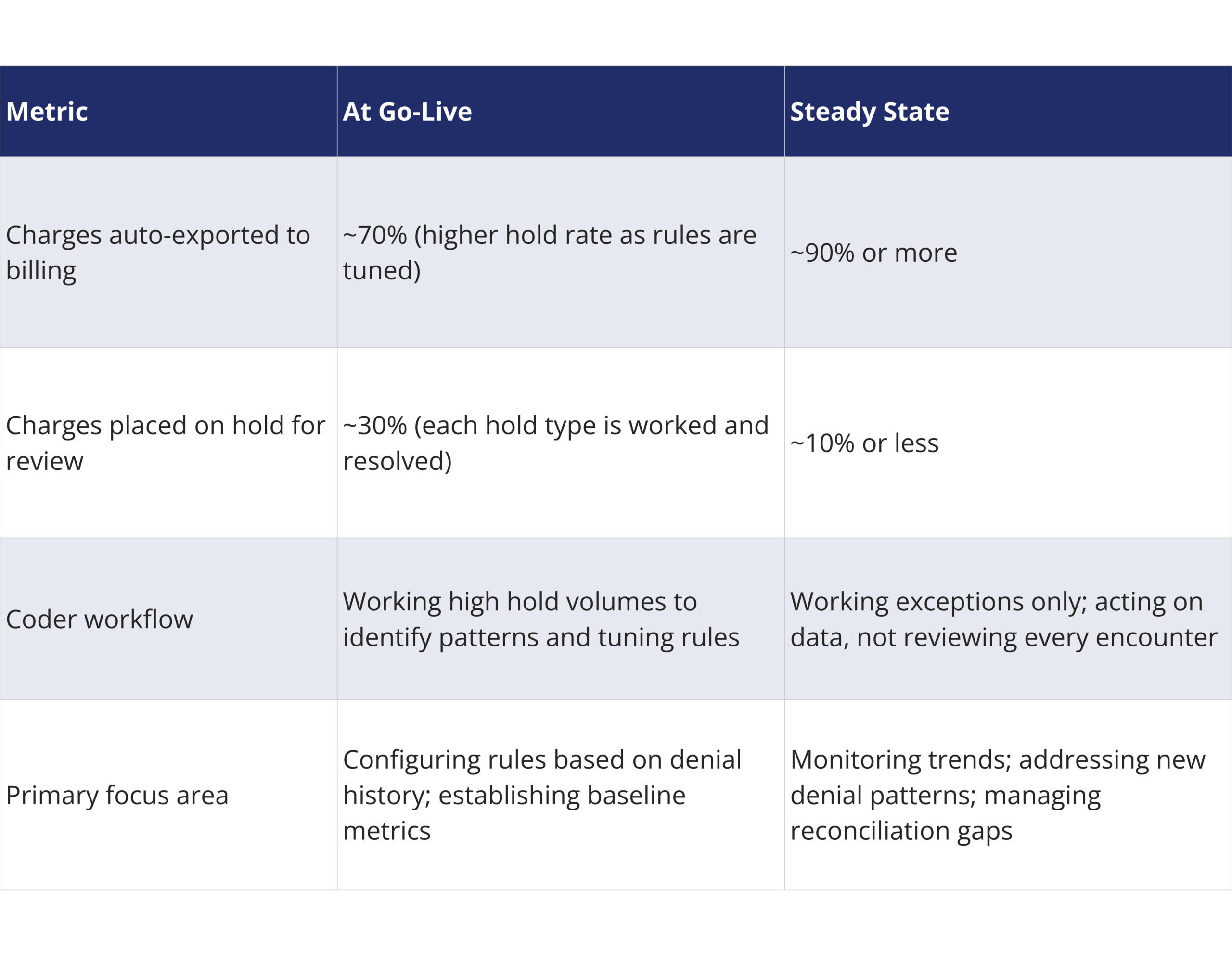
The shift from go-live to steady state takes time, and the pace depends on the organization’s denial history, complexity of its charge mix, and the organizations ability to foster changes in its workflow. What drives the hold percentage should be data, not preference. Which denial types are most prevalent? Which are costing the organization the most? Which rules, when activated, would catch those denials before submission? The rules should reflect actual denial patterns, not general caution.
How Does Exception-Based Management Change What Coders Actually Do?
In a traditional model, a coder’s day is structured around throughput: pull up a chart, assign codes, enter the charge, move to the next one. The focus is on volume. In an exception-based model, the coder’s role changes substantially.
When 90% of charges are flowing straight through to billing, the coder is no longer responsible for touching every encounter. The system has already evaluated the charge against the rules, confirmed it meets the requirements for clean submission, and routed it appropriately. The coder’s attention goes to the 10% that did not pass, which carry a specific, identifiable problem: a missing modifier, a diagnosis code that does not match the place of service, a patient demographic mismatch, or a payer-specific requirement that is not met.
Coders working exceptions rather than every encounter shift from data entry toward data analysis. They see patterns. They can identify that a particular provider is consistently missing a modifier, or that a specific denial type is concentrated in one department or service line. They can send feedback directly to the responsible clinical staff through the Charge Pro feedback loop. Over time, that feedback loop reduces the volume of the same exception appearing repeatedly, which is how the hold rate at go-live becomes the steady-state rate over time.
An organization with a large team manually reviewing every encounter is not using that capacity strategically. An organization with a smaller team working exceptions and managing a feedback loop back to clinical staff is doing something harder and more valuable. The freed capacity can be redeployed toward denials management, accounts receivable follow-up, and the analytical work that addresses the other drivers of denials that exception-based charge capture does not touch.
Conclusion
The financial case for exception-based charge capture is two-sided. On the labor side, the right staffing model for a well-automated workflow is substantially smaller than the model built around manual review of every encounter. On the revenue side, fewer manual touches means fewer opportunities for coding changes to introduce inconsistencies that trigger payer denials.
For a finance leader evaluating the operational impact of Charge Pro, the metrics worth watching are not limited to denial rates. Charge throughput rate, hold resolution time, touch count per exception, and missing charge volume are all leading indicators of revenue cycle health that become visible and trackable once the workflow moves to exception-based management. These metrics address one specific layer of the denial picture. Addressing the full picture requires the same data-driven approach applied across every driver, from eligibility and authorization through coding and charge submission.
Diagnosis code accuracy is one of those other layers. For a closer look at how codes degrade as they move from physician documentation into the charge system, and what that degradation costs at the payer, see the companion article: The Documentation Is Accurate. So Why is the Claim Getting Denied?
FAQs
What is exception-based charge management?
Exception-based charge management is a workflow model in which a charge capture system automatically validates every encounter against a configured rules engine and routes only the charges that do not meet clean-submission criteria to human review. In a healthy state with Charge Pro, approximately 90% of charges move directly to billing without coder intervention. Coders focus their time on the 10% that require attention. This approach targets one specific source of denials, which is variability introduced by manual handling, and should be used alongside other denial reduction strategies that address eligibility, authorization, and credentialing.
How does Charge Pro determine which charges go on hold versus straight through to billing?
Charge Pro evaluates every charge against a three-layer rules engine: the FinThrive standard Centers for Medicare & Medicaid Services (CMS) edits, custom rules built for each organization based on their specific denial history and payer requirements, and system-built rules covering common validations like age, gender, and place of service. Charges that pass all applicable rules are auto-exported to billing. Charges that do not pass are placed on hold with a notification for the coder explaining the specific issue.
What financial metrics should a CFO track after implementing Charge Pro?
Key metrics include charge throughput rate (the percentage of charges auto-exported without coder intervention), hold resolution time (how long it takes for exception charges to be worked and submitted), touch count per exception (how many people had to handle a charge before it was resolved), and missing charge volume (encounters where no charge was captured despite documentation). These metrics track the impact of exception-based management on the portion of denials tied to manual handling. Other denial drivers, such as eligibility and authorization, require separate tracking and tools.
Will automating charge capture require reducing coding staff?
It depends. Organizations typically find that exception-based management changes what coders do. Coders shift from manual data entry on every encounter to working exceptions, managing the feedback loop back to clinical staff, and focusing on the denial types with the highest revenue impact. In cases where staffing reduction is a goal, automation provides a defensible path to right-sizing based on encounter volume and exception rate. The capacity freed up by automating charge review can be redirected toward the other denial management work that exception-based capture does not address.

About The Author
Gary Bernklow is the Director of Product Management at medaptus, where he has spent nearly two decades shaping the company’s revenue cycle software solutions. With over 30 years of experience in hospital revenue cycle management, Gary brings deep expertise in charge capture, coding automation, and billing workflows.
Get the latest updates and news delivered to your inbox.
Subscribe to our newsletter today.