










Blog Summary
Charge capture and charge entry are two related but distinct steps in the healthcare revenue cycle. Charge capture is action-based — the physician documents the services they performed and submits the charge. Charge entry is function-based — coders review that charge for validity, match it to clinical documentation, correct errors, and route it to billing. Both steps must work together seamlessly for accurate, timely reimbursement. Medaptus Charge Pro automates and integrates both steps, reducing revenue leakage, accelerating charge throughput, and ensuring compliance.
Charge entry and charge capture are two very important parts of the billing cycle and may also be referred to as the reconciliation process. To maximize reimbursements, it is important that providers are documenting the correct type of codes, and it is also very important that the coders in the charge entry process catch any errors to mitigate compliance issues and denials.
What Is Charge Capture in Healthcare?
Charge capture is the process of a healthcare provider documenting and recording their performed services and submitting those charges for payment to a patient or insurance company. In order to successfully generate revenue, charges must not only be captured but also be complete, accurate, and properly entered into a charge capture solution where it can be sent to billing.
What Is Charge Entry and How Does It Differ from Charge Capture?
Charge capture and charge entry are two different parts of the same process, but the terms are often used interchangeably. The main difference in charge capture and charge entry is one is action-based whilst the other is function-based.
Charge capture typically refers to the process of just getting the charge in the door. A physician sees a patient, and needs to document who they saw, when they saw them, and what they saw them for. In most healthcare settings, they have to submit charges that are then reviewed by the coding and billing teams.
Charge entry is a set of processes that include steps like:
- Coders review charges to check for validity
- Coders review provider documentation to ensure it matches the codes
- Coders communicate back to providers to request any missing information
- Charges are sent to payors for billing.
Charge capture and charge entry in healthcare is a complex process, and a simple error can result in a lower reimbursement or reconciliation issues. A charge capture software like our Charge Pro solution automates many processes so that you can reduce revenue leakage and automate charge processing, ultimately allowing providers and staff to be able to focus on the most important thing – the patient.
What Are the Most Common Charge Capture and Entry Challenges medaptus Solves?
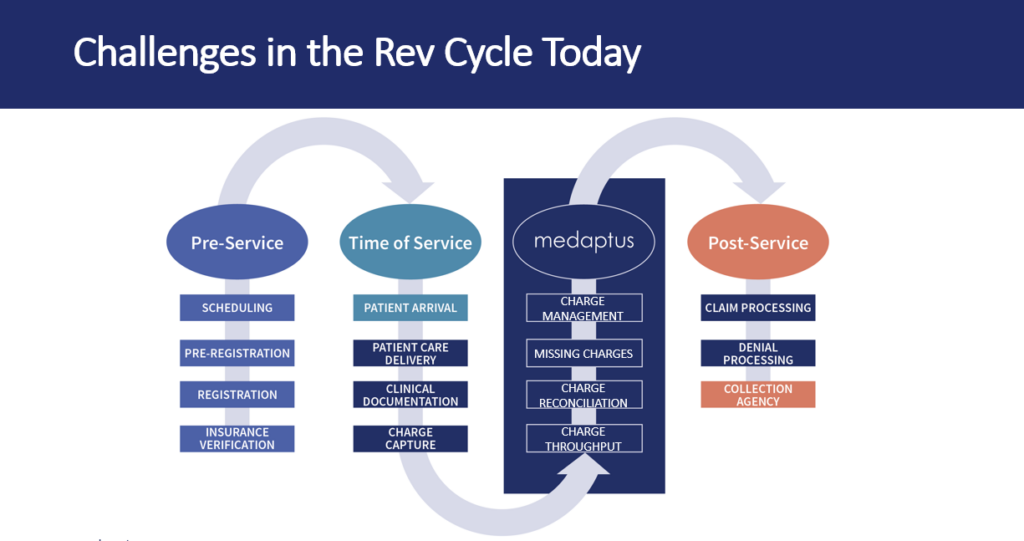
A few common challenges in the revenue cycle include disparate processes, inefficient workflows, missed charges, and incomplete reporting. These challenges can happen at any point in the revenue cycle, but they mostly occur between the time of service and post service phases. Protracted charge lag, late and missing charges, incorrectly coded encounters and overall decentralization can negatively impact revenue across many clinical areas.
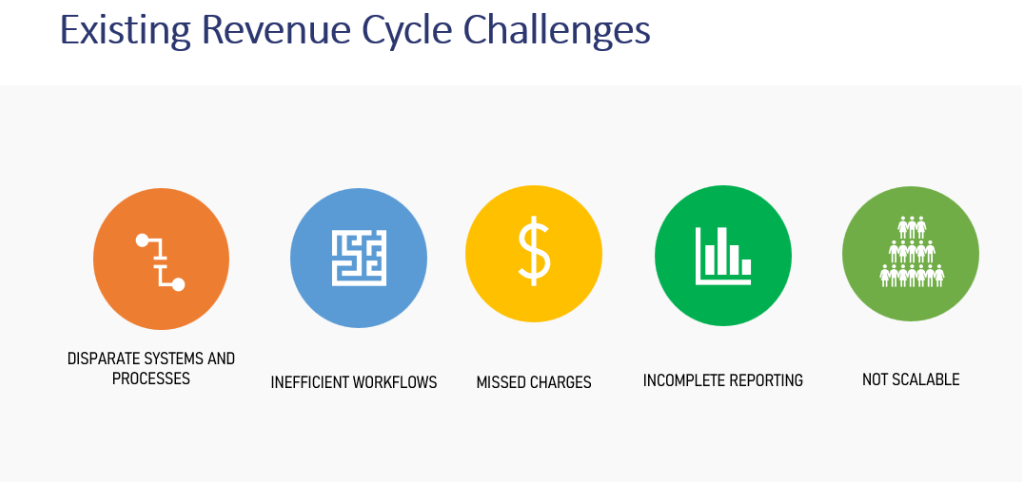
When choosing a charge capture solution vendor, there is a lot to consider. Medaptus makes it a more accurate and easy process for both charge capture and charge entry. For example, we help:
- Identify missed revenue opportunities
- Reconcile charges-to-documentation
- Improve productivity
- Integrate with our patient assignment solution
- Reduce charge lag
- Decrease insurance denials
- Accelerate cash flow
- Automatically apply compliance rules
We also look at each of our customer’s needs and what they require for charge capture vs. charge entry and adjust accordingly. For example, we create coding shortcuts/rules for CPT codes for charge entry. These can be custom or standard codes for charges based upon our customers’ needs. For charge entry, we strive to centralize this information into one easy-to-use view where you can see real-time charge reconciliation and even view under-billed encounters.
Conclusion
Charge capture and charge entry in healthcare is a complex process, and a simple error can result in a lower reimbursement or reconciliation issues. A charge capture software like Charge Pro automates many of these processes so that you can reduce revenue leakage, automate charge processing, and ultimately allow providers and staff to focus on the most important thing — the patient. For charge entry specifically, we strive to centralize information into one easy-to-use view where you can see real-time charge reconciliation and even view under-billed encounters.
FAQs
Are Charge Capture and Charge Entry the Same Thing?
They are related but different. Charge capture refers to the act of submitting a charge for a service rendered (typically by the provider). Charge entry refers to the process of reviewing, coding, and routing that charge to a payer (typically done by coders or billing staff). Both must work correctly for accurate reimbursement.
What Happens If Charge Entry Is Delayed or Inaccurate?
Delays in charge entry extend the charge lag — the time between service delivery and billing. Inaccurate charge entry leads to claim denials, underpayment, or compliance risk. Common entry errors include missing codes, documentation mismatches, and down-coded encounters. medaptus Charge Pro’s rules engine catches these before the charge reaches billing.
How Does medaptus Help with Both Charge Capture and Charge Entry?
Charge Pro addresses both steps. For charge capture, it offers a mobile app, an EMR link for in-EHR entry, and automated charge validation. For charge entry, it provides real-time reconciliation dashboards, E&M distribution reports for identifying coding patterns, and custom rules that automate the most common coding decisions.
What Is an E&M Distribution Report?
An E&M (Evaluation and Management) Distribution Report shows how charges are distributed across billing levels within a family of E&M codes — for example, office visit levels 1 through 5 for established patients. This helps coders and directors identify if providers are consistently over- or under-coding, supporting both compliance and revenue optimization.

About The Author
Vicky Abihsira is the Director of Sales and Marketing at medaptus, where she leads the company’s market strategy and business development initiatives. She specializes in connecting hospitals and health systems with solutions that improve revenue cycle outcomes and clinical workflows.
Get the latest updates and news delivered to your inbox.
Subscribe to our newsletter today.