

Blog Summary
A business case for hospital medicine operations software gets CFO approval when it translates fragmented workflows into a dollar figure, shows a payback period inside the timeline finance uses, and includes a real adoption plan. Hospital CFOs have compressed their expected return window; over half of hospital CFOs now require a new technology to return 110% of its cost within 18 months (SmartSense by Digi). That means the business case has to lead with baseline cost, payback timeline, and risk exposure, not with what the software does.
I’ve noticed something shift in the last year or so of budget conversations I’ve been part of. It used to be that a hospital medicine leader could walk into a capital request with a strong operational story and get a fair hearing on that alone. That’s not really true anymore, at least not on its own.
CFOs are under more pressure than they were even two years ago, and it shows up in how they evaluate every request that crosses their desk, including a proposal for medaptus software. This blog is written specifically for whoever has to walk into that room and make the ask, not the CMO or the COO who already feels the operational pain, but the person who has to turn that pain into a number the CFO can approve.
Why Are Healthcare CFOs Asking for Faster Returns on Operations Software?
Hospitals used to give a technology investment something like a three-year runway to prove itself. That grace period is gone. SmartSense by Digi surveyed 150 U.S. hospital financial leaders for its 2026 Hospital CFO Technology Outlook Report and found over half of CFOs now require a new technology to return 110% of its cost within 18 months.
The same report found that 62% of financial leaders now say they’d rather invest in a platform that covers multiple operational needs than string together several narrow point solutions. That matters for how you frame a hospital medicine operations request. You’re not proposing a purchase for a single-purpose tool. You’re asking for a platform that touches intake, assignment, distribution, reconciliation, and analytics. That is exactly the kind of investment CFOs say they’re prioritizing right now.
What Number Should You Lead With?
Lead with your baseline, not with the platform. Before anyone in finance cares what the software does, they need to see what the current state is actually costing the organization, in dollars, not in frustration.
Physician turnover is the clearest place to start, because the number is bigger than most non-clinical finance leaders expect. The overall estimated cost of losing a hospitalist and hiring a replacement, accounting for recruiting, onboarding, and the coverage gap in between, ranges from $27,000 to $86,500 according to research published in the Journal of Hospital Medicine.
From there, add the pieces that are easy to overlook because they don’t show up as a single line item:
- Coordinator hours spent building rounding lists by hand every morning.
- Locum coverage brought in to fill a gap.
- Overtime paid out because assignment and census tracking are running on phone calls and spreadsheets instead of a connected system.
None of these numbers require new data collection. They already exist in your payroll and scheduling records. The work is pulling them into one place.
How Do You Structure the Ask Itself?
Once you have the baseline, the ask itself needs to answer four questions in order, because that’s the order a CFO is going to ask them anyway.
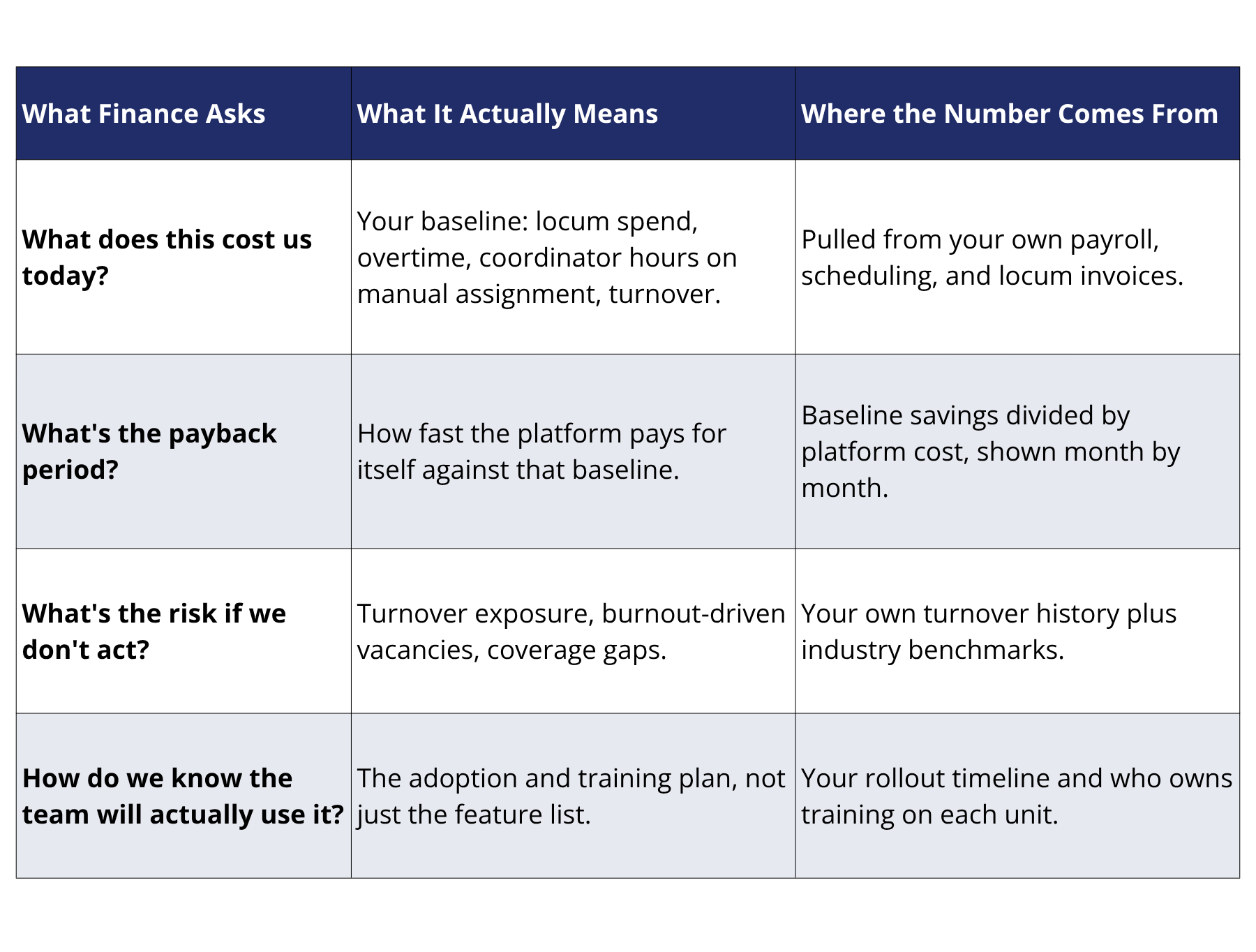
Walking in with those four answers already worked out is the difference between a business case that gets pushed to the side and one that gets approved. The adoption plan matters more than people expect here. A CFO is going to ask who owns training and rollout before they ask about the ROI model, because they’ve been burned by strong ROI models attached to platforms nobody actually used.
Conclusion
The business case that gets approved isn’t the one with the most compelling operational story. It’s the one that hands finance a baseline number, a realistic payback timeline, the risk of standing still, and a real plan for making sure the platform gets used. That’s not a lower bar than the operational case, it’s the same case, translated into the language the room you’re walking into speaks.
Medaptus Command was built to give hospital medicine leaders the coordinated system that makes this baseline-to-payback math possible in the first place, bringing intake, assignment, distribution, reconciliation, and analytics into one platform instead of several disconnected tools.
FAQs
Who should actually be building this business case?
Whoever owns the ask, usually a CMO, COO, or VP of Hospital Medicine, should build it alongside finance from the start rather than presenting a finished pitch. The cost data has to hold up under the same scrutiny finance applies to every other capital request, so it helps to have them at the table early.
What if we don’t have 18 months to show a return?
Start with the fastest-moving numbers: reduced locum spend and fewer overtime hours tend to show up within the first few months, since they respond directly to reduced manual coordination. Turnover savings take longer to materialize but should still be included as part of the full case.
Do we need a consultant to pull the baseline numbers together?
No. The data lives in systems you already have like payroll, scheduling, and locum invoices. It takes time to assemble, but it doesn’t require an outside party.
What’s the single biggest reason a business case like this gets rejected?
Leading with the operational story instead of the financial baseline. A CFO wants to see the dollar figure first and the reasoning behind it second, not the other way around.
Does a platform approach really score better than a point solution?
Based on the SmartSense data cited above, yes, 62% of hospital CFOs say they now prefer platforms that address multiple operational needs over narrow, best-of-breed tools. This is largely because disconnected point solutions have been harder to prove ROI on and harder to sustain.

About The Author
Jaclyn Corbett is the Product Manager for medaptus Command and Assign, with over 13 years working at the intersection of healthcare operations and software development. She works directly with hospital medicine programs to understand how operational workflows break down and how technology can reconnect them.
Get the latest updates and news delivered to your inbox.
Subscribe to our newsletter today.