

Blog Summary
Outpatient infusion billing is significantly more complex than inpatient billing because reimbursement depends on precise, time-based documentation of each service — including start and stop times, infusion duration, drug type, and dosage. While inpatient infusion services are covered under a single bundled Diagnosis-Related Group (DRG) payment, outpatient infusion services follow a fee-for-service model where a missing or incorrect stop time can mean thousands or millions in lost revenue. Automated infusion coding solutions can eliminate manual errors and ensure organizations capture every dollar they are entitled to.
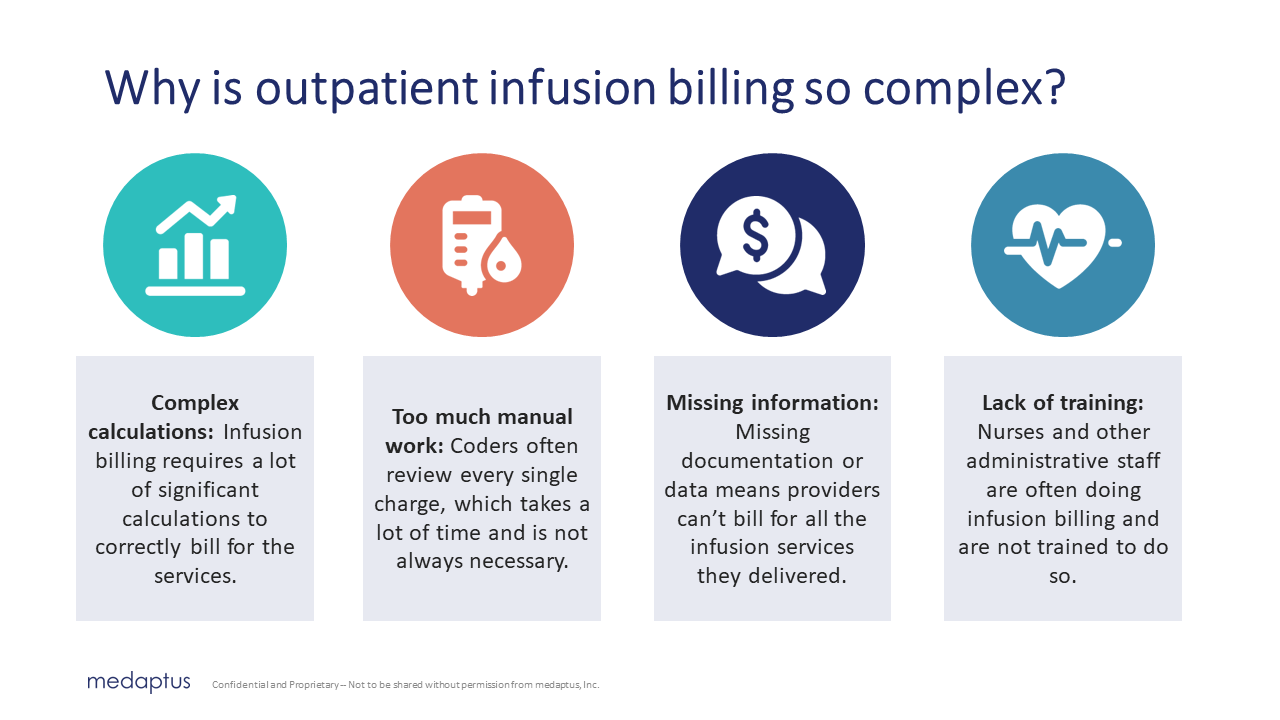
Whenever I’ve spoken to anybody that does outpatient infusion coding and billing, and I mention how complex and difficult it can be to accurately code outpatient infusion services, I get a lot of head nods, and even a few “I never want to touch infusion billing.”
Outpatient infusion billing is notoriously complex – and not something that can be done accurately manually. So what’s the difference between inpatient vs. outpatient infusion billing? And why is one more complex to code and bill than the other?
Why Is Outpatient Infusion Billing More Complex Than Inpatient Billing?
Outpatient infusion billing is far more complex than inpatient billing—and for good reason. While inpatient infusion services are bundled into a single payment under the Diagnosis-Related Group (DRG) system, outpatient reimbursement depends on precise documentation of each service delivered. That means factors like start and stop times, infusion duration, and drug type directly impact how much organizations are reimbursed. This time-based coding makes outpatient infusion billing prone to errors and revenue loss if done manually. In this post, we’ll break down the key differences between inpatient and outpatient infusion coding, explain why outpatient billing is so challenging, and show how automation can eliminate errors and ensure maximum reimbursement.
What Is the Difference Between Inpatient and Outpatient Infusion Coding?
The difference between inpatient and outpatient infusion coding is where the infusion services were delivered. This impacts what you can bill for, how you bill, and how much you can bill.
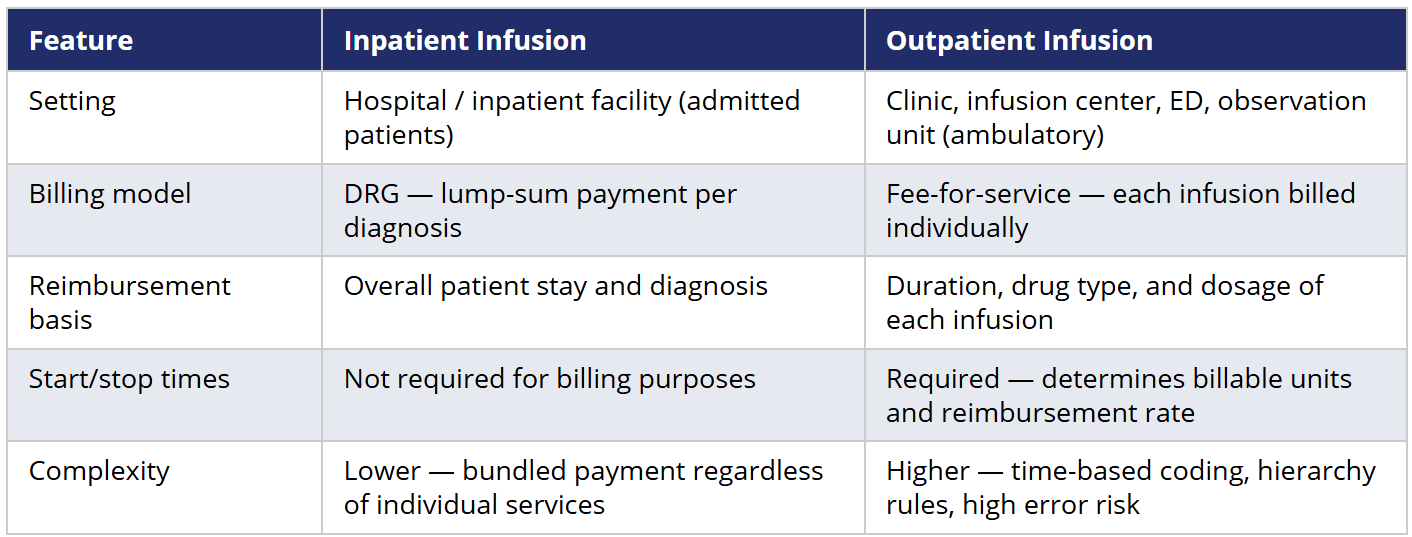
Outpatient infusion coding reimbursement refers to the reimbursement for infusion services delivered in an outpatient setting, such as a clinic, infusion center, cancer center, and it even includes emergency departments and observation clinics. Patients are typically ambulatory and are attending an “appointment” in a medical outpatient center. Outpatient reimbursement is based on a fee-for-service model, where you’re paid for each specific service – aka the infusion therapy that you deliver.
The reimbursement for outpatient infusion coding is determined primarily based on the duration of the drugs that are infused, while also considering factors such as the type of medication and the dosage of that medication.
On the other hand, inpatient infusion reimbursement refers to infusion services delivered in a hospital or other inpatient facility, for patients who have been “admitted” to the hospital. Inpatient reimbursement is usually based on a diagnosis-related group (DRG) system, where a predetermined payment is assigned to a specific diagnosis or condition. In this case, you don’t get reimbursed separately for each infusion service delivered during the inpatient stay; but rather the infusion and the other services delivered are bundled into the overall payment for the inpatient stay, based on the total DRG amount you are eligible to bill for.
Outpatient reimbursement focuses on specific services provided, while inpatient reimbursement is based on the overall care received during the inpatient stay.
One of the biggest factors that plays a significant role in outpatient infusion coding and billing are the start and stop times of delivering the infusion service. Start and stop times are typically not required in inpatient infusion coding. Here’s why.
Table 1: Inpatient vs. Outpatient Infusion Billing — Key Differences
How Does Outpatient Infusion Coding Work?
In outpatient settings, infusion therapy services are often coded based on the duration of the infusion – this is called “time-based coding.” The start and stop times help determine the total time the patient received the infusion. If duration of the infusion cannot be calculated due to missing start/stop times, the appropriate service billing code cannot be determined.
The start and stop times are used to calculate the number of billable units for each drug infused. Each unit typically represents a specific duration (e.g., 15 minutes), and the reimbursement is made based on these units. Longer durations require more billable units and hence, are reimbursed at a higher rate.
So accurate documentation of start and stop times ensures proper billing and reimbursement for the actual time the patient spent receiving the infusion therapy.
When start and stop times are being recorded manually, it leaves room for a lot of error – and missing revenue. For example, if no stop time is recorded, then the infusion must be automatically billed as a “push” (an infusion service that lasted less than 16 minutes). If this is constantly happening to infusion services you’re delivering, you’re leaving a lot of money on the table.
In another scenario, one hospital that I audited was automatically downgrading their stop times to under 16 minutes, when they could’ve – and should’ve – billed it as a “long” (over 16 minutes). This cost them three million dollars in underreported infusion services.
How Does Inpatient Infusion Coding Work?
In inpatient settings, infusion therapy services are bundled into a Diagnosis-Related Group (DRG) payment system. The reimbursement for inpatient care is based on the patient’s overall stay, including all services and treatments received. Organizations are reimbursed with one “lump sum” payment regardless of any individual services provided.
Inpatient infusion coding primarily centers around capturing the patient’s diagnosis, condition, and treatment details, rather than the specific start and stop times of individual procedures.
Since the reimbursement for inpatient care is not based on time units, the start and stop times are not as important for coding and billing purposes in the context of inpatient infusion therapy. Proper documentation is still required and may include start and stop times, but that information is not necessary to code and bill appropriately.
Conclusion
While you always want to accurately record every aspect of the services you deliver to a patient, it’s even more important to do so when it comes to outpatient infusion billing and coding. In the outpatient scenario, the start and stop times are vital to getting properly reimbursed for the therapies you delivered. If you’re not recording stop times; or if a nurse needs to write it down manually; or it doesn’t match exactly what’s in the EHR, you can be leaving thousands or millions on the table in infusion services.
That’s why we developed Charge Infusion – an automated infusion coding solution for outpatient infusion therapies. It automatically pulls the data from your EHR, removing the manual work involved, creates the appropriate charges, so you are maximizing what you can bill for – and sends it straight to billing. You can rest assured no one has to do complex calculations manually and you know you’re not missing out on infusion revenue. Learn more about Charge Infusion here.
FAQs
What Is Charge Capture in Epic?
EHRs like Epic help do the job of capturing patient documentation, transmitting patient information to capturing charges and more. However, Epic was not built as a dedicated charge capture solution. For complex workflows like outpatient infusion billing, solutions like medaptus Charge Infusion integrate directly with Epic to fill critical gaps and ensure maximum revenue capture.
What Percentage of Outpatient Infusion Services Go Unbilled When Using an EHR Alone?
When we audited various hospitals across the US, we found that up to 60% of rendered infusion services were unreported and unbilled for when relying on EHR workflows alone. In one facility — a major cancer center delivering 130,000 infusions annually — implementing Charge Infusion generated an additional $3.4 million a year in previously unreported infusion revenue.
How Does medaptus Charge Infusion Integrate with Epic?
medaptus Charge Infusion integrates directly into Epic. Infusion data is pulled from Epic, run through medaptus’ proprietary rules algorithm — accounting for duration and hierarchy complexities — and then sent back into Epic to be billed out. One tool, one easy integration, one complete solution for maximum infusion revenue.
What Are the Most Common Charge Capture Gaps in Hospital EHRs?
The most common charge capture gaps include: missing charge management (no way to identify unbilled services), documentation mismatches that lead to down-coding or charge loss, manual coding workflows done outside the EHR, inability to handle infusion hierarchies, and start/stop time errors that cause underbilling.

About The Author
Gary Bernklow is the Director of Product Management at medaptus, where he has spent nearly two decades shaping the company’s revenue cycle software solutions. With over 30 years of experience in hospital revenue cycle management, Gary brings deep expertise in charge capture, coding automation, and billing workflows.
Get the latest updates and news delivered to your inbox.
Subscribe to our newsletter today.