

Blog Summary
Medaptus Charge Pro integrates with Athena Health using a secure API job that automatically pulls encounter data, updates Charge Pro in real time, and eliminates manual charge entry. The integration reduces charge lag, improves billing accuracy, and allows coders to focus on exceptions rather than manual data entry. A configurable ‘batch time’ setting — coming in an upcoming release — will give healthcare organizations even more flexibility over data synchronization timing. The integration follows a structured four-step process: initiation and setup, API configuration, testing and validation, and deployment and optimization.
Healthcare organizations often struggle with revenue cycle management inefficiencies due to manual charge entry and billing delays. These challenges lead to administrative burdens, increased errors, and delayed reimbursements, which impact overall financial performance.
To address these revenue cycle management challenges, medaptus’ award-winning Charge Pro solution seamlessly integrates with leading healthcare EMRs and billing software, including Epic, Cerner, Meditech, Allscripts, NextGen, and Athena Health. These integrations improve billing efficiency, reduce manual errors, and enhance financial transparency for healthcare organizations.
In this blog, we explore Charge Pro’s integration with Athena Health, from technical details to benefits and upcoming enhancements.
How Does medaptus Charge Pro Integrate with Athena Health for Revenue Cycle Management?
What Are the Key Steps in the Charge Pro–Athena Health Integration Process?
Integrating our charge capture and reconciliation solution, Charge Pro, with Athena Health follows a structured approach to ensure smooth implementation and operational efficiency. For Athena clients that enter their billing in the EMR, our integration automates charge capture, reducing lag and manual errors.
Key steps in the integration process include:
- Initiation and Setup – The healthcare organization informs Athena about the intent to integrate Charge Pro.
- Configuration and API Setup – We use what’s called an API job. This allows us to automatically update Charge Pro with Athena data, ensuring real-time synchronization.
- Testing and Validation – Data exchange is tested to confirm accuracy and compliance with Athena’s revenue cycle management requirements.
- Deployment and Optimization – The integration is fully launched, and ongoing performance monitoring ensures continued success.
What Integration Challenges Does Charge Pro Overcome?
While integrating any charge capture system with an EMR presents its challenges, Charge Pro has developed solutions to streamline the process:
- Data Lag Reduction – The automation of the interface decreases lag. This means charges are processed more quickly, improving cash flow.
- Manual Entry Elimination – Customers who were manually entering their charges now have them automatically updated in Charge Pro from Athena, highlighting efficiency gains.
What Features Does the Charge Pro–Athena Integration Offer?
The integration provides automated charge capture for accurate and timely submission of charges, real-time data synchronization to reduce manual entry errors and billing discrepancies, and improved provider workflow so healthcare professionals focus more on patient care than administrative tasks. Several key features that optimize revenue cycle management are shown in the table below.
Table 1: Charge Pro + Athena Health Integration — Capabilities and Benefits
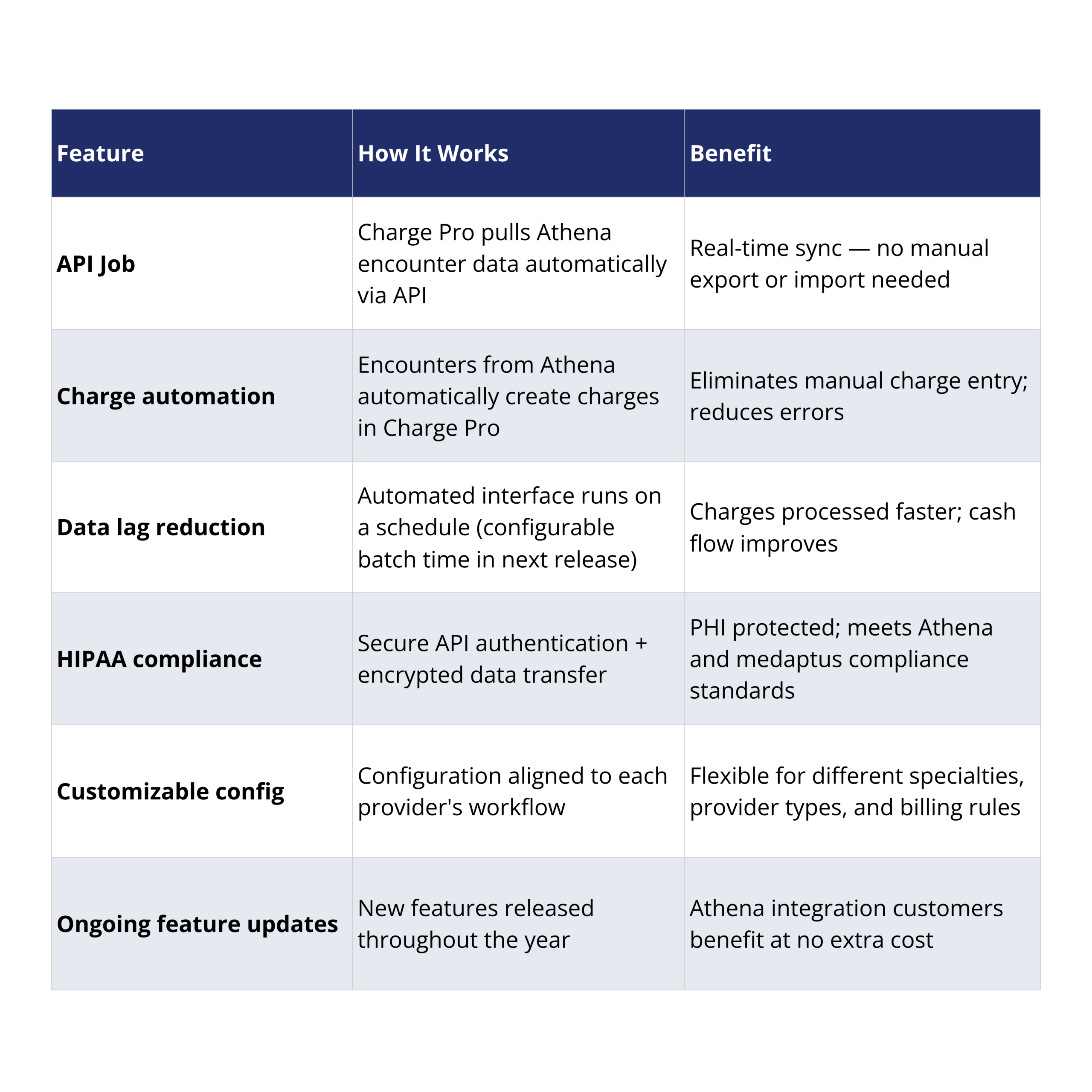
Charge Pro’s integration with Athena Health leverages secure API calls to facilitate seamless data exchange. While specific technical requirements vary, the process typically involves:
- API authentication and secure data transfer protocols.
- Compliance with HIPAA and other industry standards to ensure data security.
- Customizable configuration options for healthcare providers to align with their workflows.
What’s Next for the Charge Pro and Athena Health Integration?
Looking ahead, we continue to refine and optimize our Charge Pro integration with Athena Health. “Coming in the next release is a configurable ‘batch time’ setting, allowing providers more control over data synchronization,” shares Jeremy Smith. This upcoming feature will give users increased flexibility in managing their charge capture processes more effectively. As we make new product updates throughout the year, customers who use the medaptus and Athena integration benefit from new features at no extra cost.
Conclusion
Large healthcare organizations using Charge Pro with Athena Health have reported significant benefits. Customers are seeing significant improvements in billing accuracy and financial transparency. The feedback on the integration has been overwhelmingly positive.
Charge Pro’s integration with Athena Health for revenue cycle management significantly improves billing efficiency by automating charge capture, reducing data entry errors, and enhancing financial performance. The streamlined integration process and testing ensure its long-term benefits are fully realized, making it a valuable investment for healthcare providers.
FAQs
Does medaptus Charge Pro Replace Athena Health?
No — Charge Pro complements Athena Health. Athena remains your EHR and billing system of record. Charge Pro integrates with Athena to automate charge capture, apply coding rules, and surface missing charges — functions Athena was not designed to handle natively.
How Does the API Job Work in the Athena Integration?
The API job is an automated process that queries Athena Health at scheduled intervals, pulls new encounter data, and creates corresponding charges in Charge Pro. In the next release, the batch time will be configurable, allowing organizations to control how frequently the sync runs.
Is the Charge Pro–Athena Integration HIPAA Compliant?
Yes. The integration uses secure API authentication and encrypted data transfer protocols that comply with HIPAA requirements. medaptus also works with each healthcare organization’s IT team to align with their specific corporate security requirements.
What Specialties Benefit Most from the Athena Health Integration?
Any specialty that uses Athena for billing can benefit, particularly those with high encounter volume or complex coding requirements. Organizations with charge lag challenges — like the Radiology specialty at Peterson Health — often see the most immediate improvement in cash flow acceleration.

About The Author
Jeremy Smith is an Integration Engineer at medaptus with over 12 years of experience in healthcare technology implementation and systems integration. He specializes in creating seamless data flows between EHR platforms and the medaptus suite, working cross-functionally with development, implementation, and technical operations teams to ensure customers experience no disruption or redundancy across systems.
Get the latest updates and news delivered to your inbox.
Subscribe to our newsletter today.