
Blog Summary
Hospitalist handoffs break down when critical patient information is shared through fragmented tools. The disconnected process makes it easier to miss new admissions, overnight clinical changes, and patient ownership updates, increasing administrative work and the risk of communication errors. A structured handoff process should have automated patient assignments, real-time census updates, integrated handoff notes, and automatic attending updates.
Hospital medicine teams deal with two distinct types of handoffs:
The first is the daily shift change where day providers sign off to nocturnists (or vice versa). This happens day. Twelve to fifteen providers who have been rounding all day pass their census to 2 to 4 nocturnists. The incoming team needs to know who their patients are, what changed during the day, and who came in after the morning assignments were set. The tools most teams rely on for that transfer, like texts, verbal rundowns, and EHR messages, were not built for it.
The second is changeover day. On a 7-on, 7-off schedule, your entire team turns over at once so every patient gets a new attending. The list has to be rebuilt, the EHR has to update, and providers who are brand new to the census need enough context to start rounding the next morning. At a mid-size health system, that might mean 600 patients changing hands at once.
Both of these transitions create risk. And in most hospitals, both are still managed largely by hand. It is worth asking whether your current process for both your daily and weekly transitions is as reliable as it should be.
Why Are Hospitalist Handoffs So Complicated?
The staffing math is part of it. Moving from 12 to 15 providers splitting the work during the day to 2 to 4 nocturnists at night is a ratio shift that creates pressure.
But the bigger issue is structural. Nocturnists are not doing traditional rounding on all patients overnight. They are responding to emergencies, managing escalations, and supporting patients when needed. By the time the morning team comes back, a lot has happened that no one has formally summarized.
The incoming day providers need to know three things: who are my patients, what changed overnight, and who came in after I left. In most hospitals, getting those three answers requires checking multiple systems, calling someone, or hoping an email arrived.
What Actually Breaks Down During a Provider Handoff?
In our experience, the same issues come up over and over. They are not dramatic failures, but structural ones.
- No standard format. Different providers hand off differently. Without a standardized process, the receiving provider has no way to know what is missing.
- Fragmented tools. A handoff that happens over text is not a handoff but rather a best-effort summary. There is no confirmation of receipt, no record, and no way to audit it later.
- New admissions falling through the cracks. If a patient came in at 2 AM and nobody flagged them, the day team may not find out until rounds.
- Manual EHR updates on changeover day. At a mid-size health system, you might have 600 patients getting a new attending on changeover day. If that update is manual, you are looking at hours of administrative work. During that window, the EHR is out of sync.
What Should Be in Every Handoff?
When designing a reliable handoff process from scratch, it should consistently include:
- All new admissions since the last shift, with relevant context
- Status updates on current patients with overnight changes
- A clear list of watch items and expected needs
- Assignment ownership: who is responsible for which patient, and why
- One place where both the outgoing and incoming team are working from the same information
How Does Assign Improve Provider-to-Provider Handoffs?
We built our handoff workflow in Assign around three core mechanisms. Most sites use all three, but the right mix depends on how your team is structured.
Mechanism 1: Full handoffs. The outgoing provider transfers all of their patients to the same incoming provider. This is common at smaller sites. It is straightforward, and it keeps communication clean because all of the outgoing provider’s patients go to the same person.
Mechanism 2: Geographic handoffs. Instead of transferring all patients, providers hand off based on unit location. If you are covering a specific floor, you hand off your patients on that floor to the incoming provider assigned there. This works well for multidisciplinary rounds because everyone is physically in the same area. Any patients you picked up elsewhere during the shift (Ex. ER transfers) also handoff to the unit they are in.
Mechanism 3: Redistribute. On changeover day, when an entirely new set of providers comes on, sometimes the right move is to redistribute patients from scratch rather than do a traditional handoff. Everyone gets a fresh, balanced list. This is especially useful when you are also reorganizing by geography. Since all patients are getting a new doctor anyway, you might as well optimize their assignments at the same time.
In all three cases, Assign automates the logic. Providers are not manually looking at one list, then the next, trying to figure out who gets what. The rules handle it.
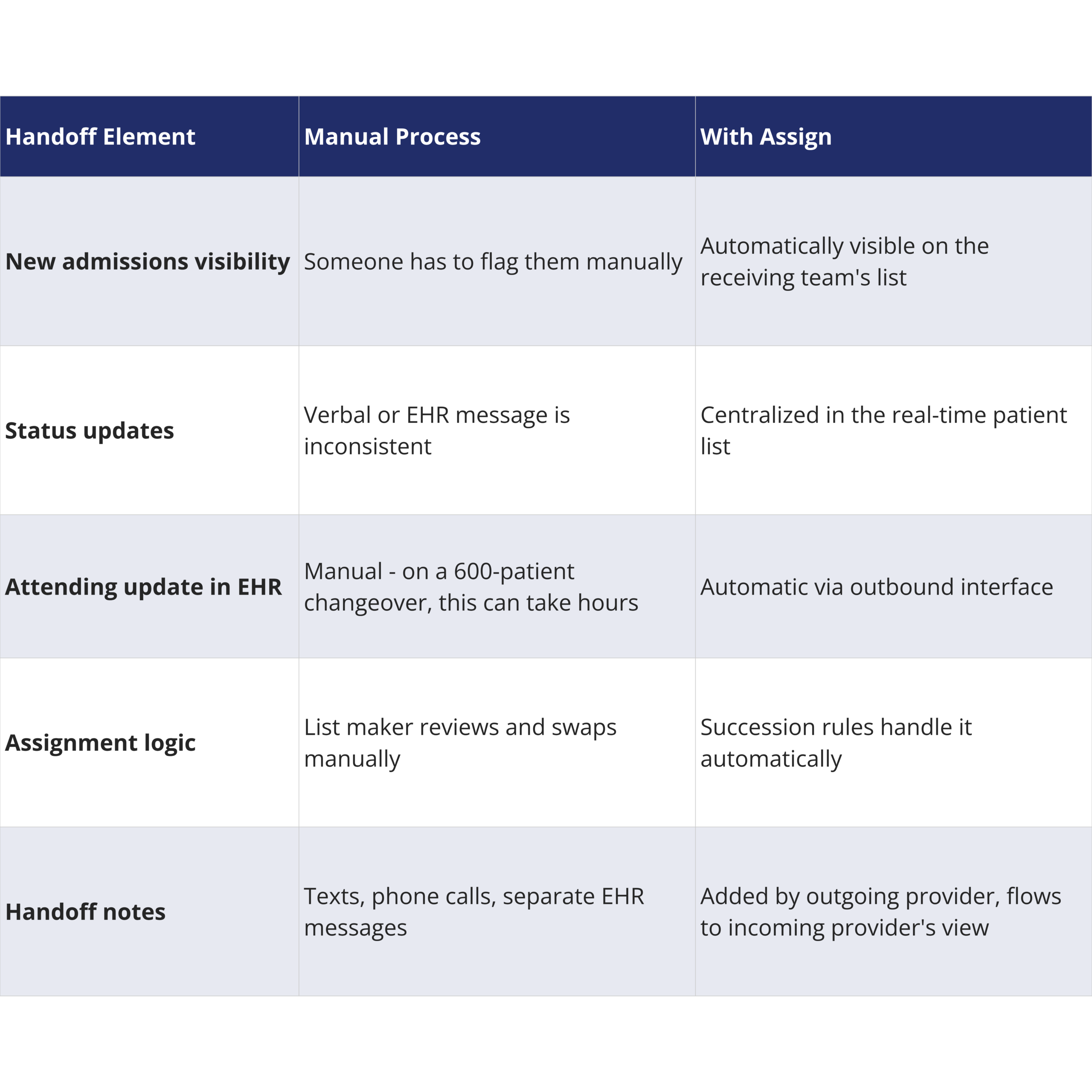
Manual Process vs. Assign-Supported Handoff
Automatic Attending Updates in the EHR
This one has a big operational impact on changeover day. When patients are getting a new attending, that update has to happen in the EHR, and in most places that is manual work. We have seen sites where two full-time staff spend hours on changeover day doing nothing but updating attendings.
Assign’s outbound interface handles that automatically. The update happens as part of the assignment process. The EHR stays current without anyone touching it.
The Distribution Summary Report
Another way to improve nocturnist-to-day transitions is with the Assign Daily Snapshot. This is a distribution summary report that gives the incoming day team a structured summary of what happened overnight: new admissions, patient updates, what the nocturnist team handled.
Today, nocturnists typically send that update manually via an email, a chat message, or verbally at 7 AM. The Daily Snapshot replaces that entirely. For nocturnists who are also managing the list overnight, it is even more valuable. They are responsible for the census and the overnight summary, and now both come from one place.
Handoff Notes in the Rounding List
For clinical context that goes beyond structured data, we built a handoff notes field. The outgoing provider adds a note before they leave. It shows up in the incoming provider’s view the next morning. No extra steps, no separate message.
What Should Hospital Medicine Leaders Look for in Their Current Process?
Here are the questions we ask when we start working with a new site:
- How do your nocturnists find out about patients who came in overnight?
- On changeover day, how long does it take to update attending assignments in your EHR?
- When a provider ends their shift, how do they communicate clinical context to the next provider?
- If something was missed in last night’s handoff, how would you know?
If any of those answers involve a lot of manual work or informal communication, that is where we start the conversation.
Conclusion
The manual, fragmented approach most teams are using for handoffs does not have to be permanent.
What we have seen across implementations is that once providers learn about how Assign works, they stop doing the manual coordination. They stop texting each other to swap patients. They stop spending changeover mornings on EHR updates. That time goes back to patient care.
If you want to see how this works in practice, we are happy to walk through it.
Learn more: medaptus.com/assign
FAQs
Why are hospitalist handoffs such a high-risk part of care?
The combination of high patient volume, rapid staffing transitions, and fragmented communication tools creates predictable gaps. The shift from 12-15 day providers to 2-4 nocturnists means each nocturnist is covering far more patients with less context about what happened before they arrived.
What information is most often missed during provider handoffs?
New admissions, overnight clinical updates, and assignment ownership are the most common gaps. New admits that arrived after shift change are particularly easy to miss if no one flags them manually.
How does Assign support safer handoffs?
Assign automates the handoff logic through succession rules, surfaces new admissions automatically, updates attending assignments in the EHR without manual work, and provides a Distribution Summary report so the incoming team always knows what happened overnight.
Does Assign replace the EHR?
No. Assign works alongside the EHR. It handles the operational layer (patient assignment, handoff logistics, and workload balancing) that EHR workflows were not built for. The two systems stay in sync through the outbound interface.
How can leaders tell if their handoff process needs improvement?
The clearest indicators are morning surprises where the day team learns something about their patients that should have been communicated overnight. Others include nocturnist frustration, long EHR update times on changeover day, and inconsistent documentation across providers.

About The Author
Jeff Cibotti is a Senior Solutions Consultant at medaptus with nearly 15 years of experience in healthcare technology. He specializes in hospital medicine workflow, patient assignment automation, and EHR integration.
Get the latest updates and news delivered to your inbox.
Subscribe to our newsletter today.