










Blog Summary
Most physician groups track charge lag, but an organization-wide average can look healthy while one facility, group or coder runs at double the rate. Vicky Abihsira, Director of Sales and Marketing at medaptus, lays out the benchmarks. HFMA’s guidance is that complete charges should be captured within three to five days of service, with late charges under 2% of the total, and medaptus recommends same-day charge entry by physicians. She explains how to check whether your charge lag number is accurate, and how to break days to charge out by facility, provider and coder, with provider, coder and export time measured separately. A sample Charge Pro report shows a 2.57-day average hiding a group at 5.56 days, and the cause turns out to be one new coder. She also explains why charge lag at facilities without an EHR interface is usually structural. Face Sheet Auto-Registration, coming in the November 16 Charge Pro release, addresses it by moving patient registration to the bedside.
Earlier this year, our customer success lead, Dave Corbett, sat down with a long-time customer, a multi-specialty physician group, to walk through their numbers. When he got to charge lag, nothing jumped out. The group’s average was under six days, and their coders were turning charges around in about two. Then he pointed to the providers, who were averaging three and a half days from the visit to the charge:
“Ideally, you do same day. I know that’s probably not realistic in many cases, but if you can shrink that down, that’s the one that you could move the needle with.”
That’s why I like this metric. One number told the group their charge capture was in good shape. Splitting it by who was holding the charge gives you information to drill down and look for the bottleneck.
The benchmarks, and whether your number is accurate
Most groups already track charge lag. What varies is whether the number is calculated the same way from site to site, and whether it’s broken out far enough to show where the days are going. The benchmarks are the simple part. HFMA’s guidance is that complete charges should be captured within three to five days of service, with late charges making up no more than 2% of total charges (HFMA). Our recommendation at medaptus lines up with that: same-day charge entry by physicians, and three to five days in total from point of care to charge export.
Before you compare your number to those, check three things about how it’s calculated:
- Where it starts and stops. Lag measured from date of service to charge entry and lag measured to export can be days apart. Know which one your report uses, and whether it separates provider lag (visit to charge entry), coder lag (entry to coding complete), and export lag (coding complete to billing).
- What happens to hold time. If your group holds charges on purpose, for a documentation review or a set hold period, that time is either inside the number, making lag look worse than your process is, or excluded, making it look better. Either can be right, as long as you know which.
- How far down it goes. An organization-wide average blends every facility, group, provider, and coder. If your report can’t break lag out at those levels, the outliers are averaged away.
The last one is usually the hardest. If getting lag by facility and by coder means a day of spreadsheet work, it’s hard to look at it every month.
Why the days matter
The obvious cost is cash: a charge that leaves late gets paid late. There are two less obvious ones.
First, charges that are missing get harder to recover as they age. The patient has moved on, the provider’s memory of the visit has faded, and the filing deadline is closer. Medicare requires claims to be filed no later than one calendar year after the date of service (42 CFR 424.44), and many commercial payers set shorter limits.
Second, a charge entered three days after the visit is entered from memory. The diagnosis tends to be less specific than what the provider was thinking at the bedside, and the visit level is more likely to be coded conservatively. That gap doesn’t show up on a lag report, which is part of why it persists. I’ll come back to charge holds and denials in a separate post on the window before RCM.
An average can hide the site that’s costing you
Here’s a sample Charge Lag Report by group from Charge Pro.
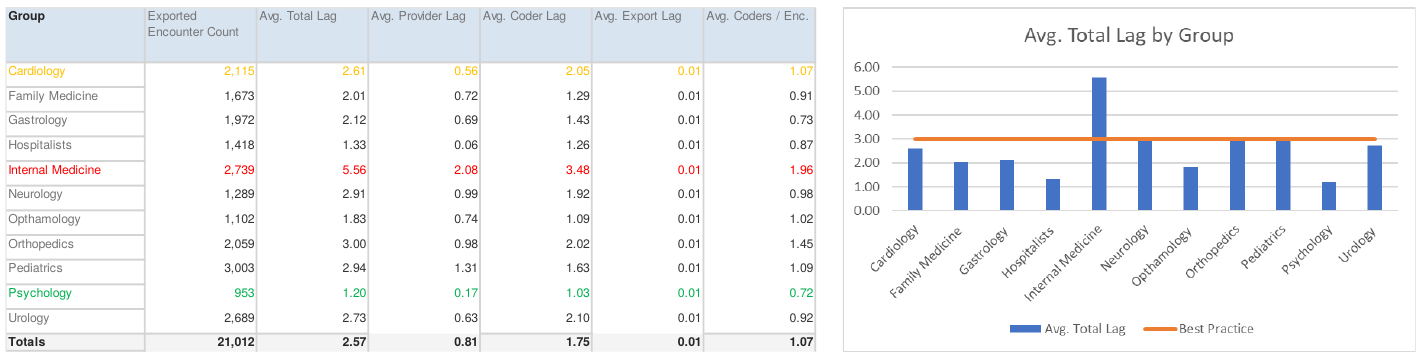
Sample Charge Pro Charge Lag Report by group. The orange line marks this organization’s three-day lag policy. (Sample data.)
The organization’s overall average is 2.57 days, well inside the three-to-five-day range. Internal Medicine is at 5.56 days, more than double. Drilling into Internal Medicine by provider and coder shows why:
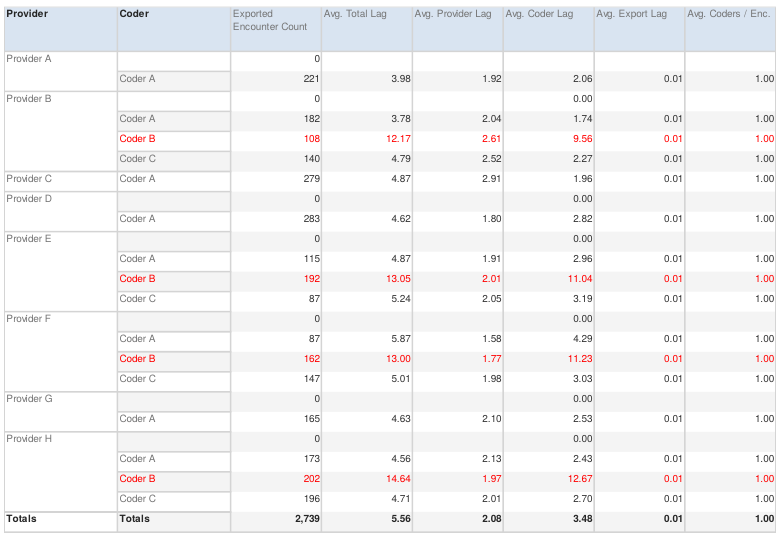
Sample drill-down of the Internal Medicine group by provider and coder. (Sample data.)
Provider lag is fairly steady, at around two days. One coder, who is new to the organization, has coder lag between about 9.5 and 12.7 days across providers, while the other coders sit between about 1.7 and 4.3. Now you know the fix. It’s more training and a lighter charge volume for that coder until they’re up to speed. The organization-wide number wouldn’t have shown it.
How to measure days to charge by site
You don’t need to buy anything to run this analysis. You need three months of charge data and an afternoon:
- Measure from date of service. Calculate days from date of service to charge entry and to charge export for each encounter.
- Break it out. Report by facility and by provider group, not just organization-wide, and split provider lag from coder lag and hold time.
- Weight by volume. A small group with an excellent lag number proves very little. The ones worth studying hold a short lag across high encounter volume, because that’s a workflow that scales.
- Sort and look at the top. Put the slowest sites and groups first, and note which ones have an EHR interface and which don’t.
In multi-facility groups, it’s worth checking whether your slowest sites are the ones with no patient data feed. Those are the places where providers are most likely working from paper, and where charges have the furthest to travel.
What to do with the outliers
A high-lag outlier usually points to one of a handful of causes:
- Training: a new provider or coder who isn’t fully up to speed
- Communication: confusion over who is working which charges, and when
- Submission: a provider on vacation who didn’t submit charges before leaving
- Workload: a coding team carrying more volume than it can turn around
- Workflow: a step in the process that adds days without adding value
Where two similar teams are far apart, have the faster one walk the slower one through how they work. Then separate process problems, which training and communication can fix, from infrastructure problems, which they can’t.
When the lag is built into the site
At a facility with no interface, the patient isn’t in your system when the provider sees them. Registration has to happen before the charge can, and it usually happens later, in another building, by another person, from whatever paper came back. I’d put that in the infrastructure column. The lag at that site isn’t a training problem, and no amount of reminders will close it. (We’ve written more about why those interfaces often never get built.)
That’s the problem our new Charge Pro module, Face Sheet Auto-Registration, is designed to solve. The provider photographs the face sheet, printed or on the facility’s computer screen, and Charge Pro registers the patient automatically. The provider goes straight to procedure and diagnosis codes and submits the charge before leaving the room. Registration moves from after the fact to the bedside, and the charge can go in the same day.
How we look at lag with our customers
Charge Pro’s Charge Lag Report breaks lag out by facility, group, location, provider, and coder, splits provider, coder, and export time, and trends it by month. The Missing Charges Report shows how many charges are missing by facility and by provider, and how long they’ve been outstanding. Our customer success team reviews these with customers as part of regular account reviews, the way Dave did with the group above. You can read more about how customers use Charge Pro reports here.

Sample Charge Pro Missing Charges Report by facility, with missing charges grouped by age in days. (Sample data.)
See it in action
We walk through our new Face Sheet Auto-Registration for Charge Pro live in this on-demand webinar, including what the workflow looks like at a site with no interface.
And if you do one thing before then, run your charge lag by site and look at the top three. I’d bet at least one of them surprises you.
FAQs
How do we know if our charge lag number is accurate?
Check where it starts and stops (charge entry or export), whether scheduled hold time is included or excluded, and whether you can break it out by facility, provider group, provider, and coder. An organization-wide average that can’t be broken down will hide the outliers.
What is a good charge lag benchmark?
HFMA guidance is that complete charges should be captured within three to five days of service, with late charges no more than 2% of total charges. medaptus recommends same-day charge entry by physicians and three to five days in total from point of care to charge export.
How should we measure charge lag?
Measure days from date of service to charge entry and to export, then break it out by facility, provider group, provider, and coder instead of looking only at the organization-wide average. Weight the results by encounter volume, and account for any scheduled hold periods.
Why is charge lag often higher at facilities without an EHR interface?
At a non-interfaced facility, the patient usually isn’t in your system when the provider sees them, so registration has to happen before the charge can be entered, often later and by someone else. Capturing the patient at the bedside, for example by photographing the face sheet, removes that step.
Can Charge Pro report charge lag by facility and provider?
Yes. Charge Pro’s Charge Lag Report can be run by facility, group, location, provider, and coder, splits provider, coder, and export lag, and can be trended by month. The Missing Charges Report shows missing charges by facility and provider, grouped by age.

About The Author
Vicky Abihsira is Director of Sales and Marketing at medaptus. She has spent 15 years in marketing, more than 10 of them at Volaris Group companies, and leads the team that helps physician groups, hospitals, and health systems understand where medaptus fits in their revenue cycle.
Get the latest updates and news delivered to your inbox.
Subscribe to our newsletter today.