

Blog Summary
Medaptus integrates directly with Cerner to close charge capture and revenue cycle gaps that Cerner alone cannot address. The integration provides an EMR link for point-of-care charge entry, rounding list synchronization via ADT feeds, documentation integration for coders, and real-time charge reconciliation dashboards. One large health system using this integration saw a 3% increase in encounters and an average net revenue gain of $111K per month — totaling $1.1 million in annual financial improvement.
Providers choose Medaptus to make sure they are capturing any and all charge opportunities. If you’re using Cerner as your EHR, then the integration makes the charge capture and reconciliation process seamless. Here’s how we help solve the challenges of the mid revenue cycle from charge management to coding to billing.
How Does the medaptus Cerner Integration Improve Charge Capture and Revenue?
The Medaptus Cerner Charge Capture integration is designed to give your providers and administrators a seamless experience and reduce the need to enter data in two places. Cerner provides an ADT feed of all patient visits (interface of registration data). This will create the visits in medaptus Assign and Charge Pro.
Cerner installs the Medaptus EMR link package into PowerChart Clients. For Cerner clients who are also using our patient assignment software, Assign, this further enhances the provider/patient relationships. The providers are assigned to patients in Assign and then updated automatically in Cerner and this creates accurate rounding lists.
In this piece, we’ll describe a few key aspects of the integration:
- EMR link
- Rounding list interface
- Documentation integration
- Charge reconciliation
How Does the EMR Link Streamline Charge Entry in Cerner?
The EMR link creates a streamlined workflow for providers to go from entering documentation to completing charge capture in a timely and efficient manner. The EMR link means you can access Medaptus’ charge capture solution directly in Cerner PowerChart – no need to log into a new platform and remember a new password.
Many of our Cerner customers use our EMR link to make it easier to enter charges. Directly from the patient record/encounter, physicians can open a Medaptus window to the same patient, enter the charge in that Medaptus window, and then close it to resume working in the EMR. It can pass diagnosis codes if they are documented in Cerner so that all the provider needs to do is enter the CPT code.
All the coding rules that exist in Medaptus to automate the charge entry process – ensuring that the majority of charges can go straight to billing without coding intervention – can exist for you in Cerner, through this Cerner charge capture integration with Medaptus.
How Does the Rounding List Interface Support Missing Charge Identification?
The rounding list interface helps to streamline the providers’ workflow. We have a Rounding List interface to pass any existing interfaces you have in your Cerner EMR or we can use the data sent to us in the ADT to create the rounding list in Medaptus if you don’t.
Rounding Lists can be used to make it easier for providers to charge their patients and for both providers and coders to ensure there are no missing charges.
With this interface, patient/provider relationships are translated into charge opportunities on their rounding lists. The charge opportunities are either fulfilled by:
- Physician captures charge via EMR link, or
- Medaptus receives a feed of all charges captured within Cerner and matches them against the Medaptus rounding lists, or
- Medaptus receives a feed of all charges AND notes captured within Cerner and matches them against the Medaptus rounding lists.
The ideal Cerner implementation would be a blend where providers are capturing charges via the EMR link, while we import the notes and provider/patient relationships to create the full gamut of charge opportunities and transmit the billing data to the client’s billing system.
What Is the Documentation Integration and How Does It Help Coders?
We can pass documentation from the EMR with the Documentation integration function to allow coders to have a more efficient charge review.
On average, a coder spends 3-4 minutes per charge locating the documentation they need to complete and submit the charge accurately. They’re often logging in to multiple systems and clicking back and forth between their charge entry window and documentation.
Using the Documentation module for Charge Pro:
- One place: Coders can view the supplied documentation needed to support the codes simultaneously as they are adding or editing coding information in Medaptus.
- Documentation storage: Physician groups don’t need to access multiple systems to see all their documents and records, even if they billed it months or years ago and are no longer affiliated with that hospital.
- Scalability and centralization from multiple EHRs: One central place to view all the documentation you need for all your charges, which is extremely beneficial if you have multiple EHRs and want to centralize information.
How Can You Improve Your Revenue Optimization as a Cerner User?
Another key feature many of our Cerner clients are asking for is charge reconciliation tools for revenue optimization.
What we commonly see when hospitals are using Cerner for charge capture is that a provider will see a patient and document it in Cerner. They can then submit their CPT and diagnosis codes for that encounter.
But once it’s submitted, there’s no back-end dashboard that coders or reconcilers can go in and review the charges that were submitted in real-time; or identify if a provider missed a patient and is missing a charge. This makes revenue optimization difficult.
Medaptus’ Charge Pro software makes this simple. You can easily view missing charges, scrub those charges and get them to billing faster – with a real-time dashboard. Integrated with your Cerner EHR, you’re not inputting any data twice – but now you have a connecting tool between Cerner and your billing software to identify missing charges.
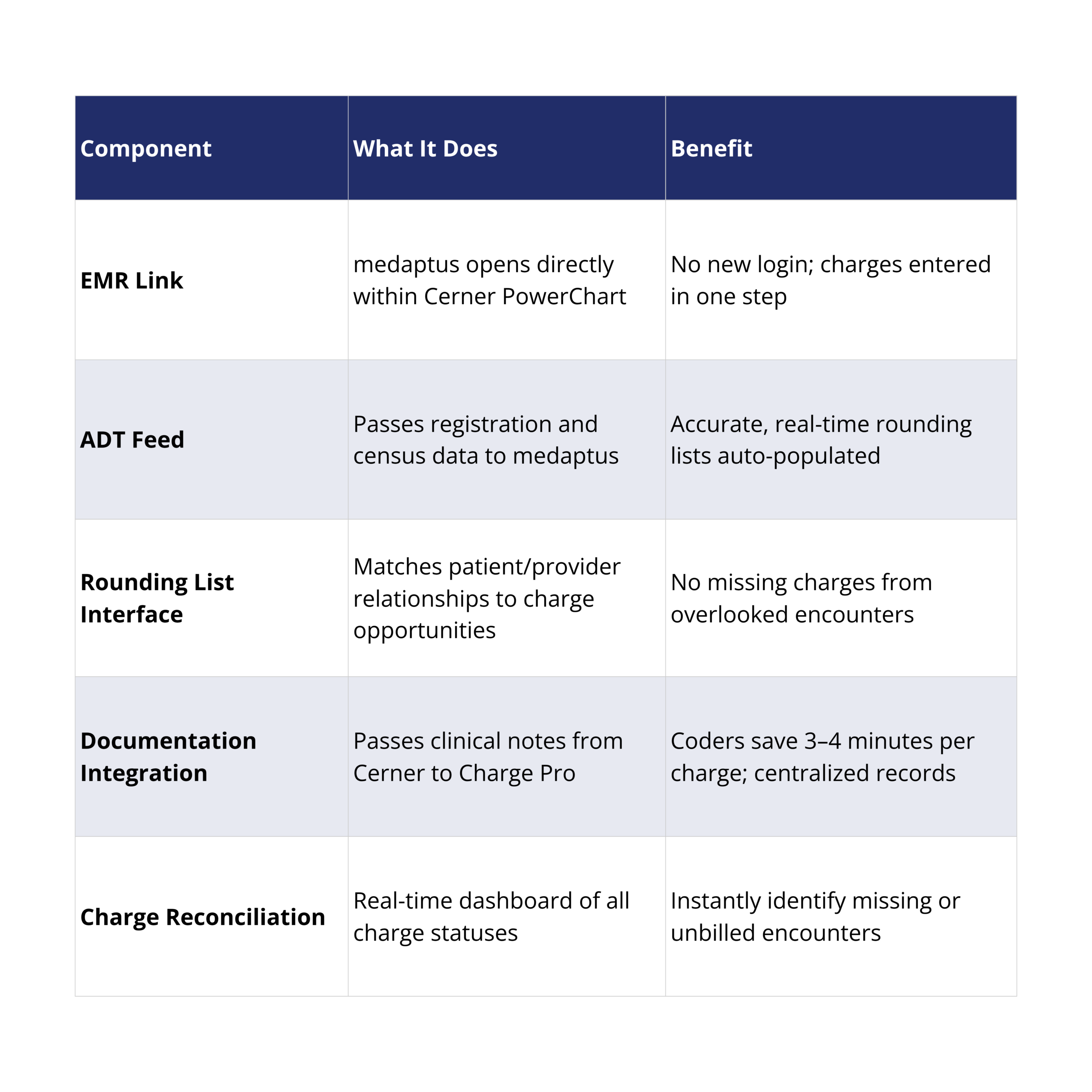
Table 1: medaptus Cerner Integration — Key Components
How Did One Health System Achieve a $1.1 Million Financial Improvement?
One of our customers is a large health system that was using Cerner as the EHR. They noticed significant challenges and were concerned that they were missing charges since they had no centralized view of all charges. As well, when charges were identified as missing, it took too long to get providers to put in the missing information, which delayed reimbursements. As well, they were spending a significant amount of time and resources on the reconciliation process.
They chose Medaptus’ Charge Reconciliation tool to accelerate charge capture, decrease administrative time, and improve visibility and reliability. Since using Medaptus’ Charge reconciliation tool, integrated with Cerner for revenue optimization, they have seen a 3% increase in encounters, resulting in an average net revenue gain of $111K per month from billable charges. This amounted to a total of $1.1 million financial improvement.
Conclusion
The feedback we typically hear from hospitals using Cerner for charge capture and integrating with Medaptus is that now:
- They’re confident they’re capturing the most charge opportunities possible
- It’s easy to see which encounters are not billable, so as not to waste time on them
- It’s easy to uncover if a user accidentally or incorrectly closed a charge opportunity without a valid reason
Are you using Cerner for your EMR and finding gaps in your charge capture or revenue cycle process? Reach out to hear how our customers are using Cerner and Medaptus to solve these gaps.
FAQs
Does medaptus Replace Cerner for Charge Capture?
No — medaptus complements Cerner. Your Cerner EHR remains the system of record for patient documentation, and medaptus fills the charge capture, reconciliation, and revenue optimization gaps that Cerner was not designed to address. The two systems work together through direct integration.
What Financial Results Have Cerner + medaptus Customers Seen?
One large health system achieved a $1.1 million financial improvement, driven by a 3% increase in captured encounters and an average net revenue gain of $111,000 per month for just one department. Results vary by organization size and specialty mix.
How Long Does the Cerner Integration Take to Implement?
Most medaptus integrations take approximately three months from contract signing through go-live. The process involves configuring the ADT feed, EMR link, and optionally the documentation and rounding list interfaces. medaptus works closely with hospital IT teams throughout.
Can medaptus Work With Cerner If We Don’t Use the Assign Module?
Yes. While Assign enhances provider/patient relationships and rounding list accuracy, Charge Pro’s Cerner integration for charge capture and reconciliation works independently. Organizations can start with charge capture and add patient assignment functionality later.

About The Author
Lisa Schwenker is a Senior Project Manager at medaptus with over a decade of experience helping healthcare organizations improve operational efficiency through technology and workflow optimization.
Get the latest updates and news delivered to your inbox.
Subscribe to our newsletter today.