
Blog Summary
Hospital medicine runs 24/7, but most tools were designed for a single daily cycle: morning assignments. True continuous operations require five core workflows — intake, assignment, census visibility, distribution, and overnight readiness — running in real time across every shift. This article breaks down what that actually looks like, and how medaptus Command supports it.
At 7:00 AM, everything looks coordinated.
The morning team logs in. Assignments are set. The census is updated. Providers know their patients.
By 2:00 PM, something has shifted.
Two ED admits are waiting for assignment. The coordinator has been on the phone three times. Someone pulled up the spreadsheet to update it, but it’s already out of date. The night team doesn’t hand off until 7:00 PM, and nobody’s sure what will come in between.
This is what most hospital medicine programs look like outside the morning window. Not chaotic, exactly. But fragile. Built for a single daily cycle in a department that runs continuously. Understanding what true 24/7 operations looks like, and what it requires, is the first step to closing the gap.
Why Does Hospital Medicine Only Feel Organized in the Morning?
Most hospital medicine tools were designed to solve the morning problem: creating a balanced rounding list before rounds begin. And they do that successfully.
What they weren’t designed for is everything that happens after.
Between 10 AM and 7 AM the next morning, the HM program is still running. Admissions are still coming in. Patients are being discharged and transferred. Providers are wrapping up one shift and handing their patients off to their colleagues. The census is changing, workloads are shifting, and someone is manually trying to keep it all in sync.
For most programs, there is no system running those 14-plus hours. There are tools, workarounds, and people filling the gaps. The morning assignment looks clean because it was built. The rest of the day runs on improvisation.
What Does 24/7 Hospital Medicine Operations Actually Require?
True 24/7 operations aren’t about more staff or longer hours. It’s about having systems that run continuously, not just once in the morning.
Five core workflows need to operate throughout every shift. When even one of them breaks down, the gaps compound quickly.
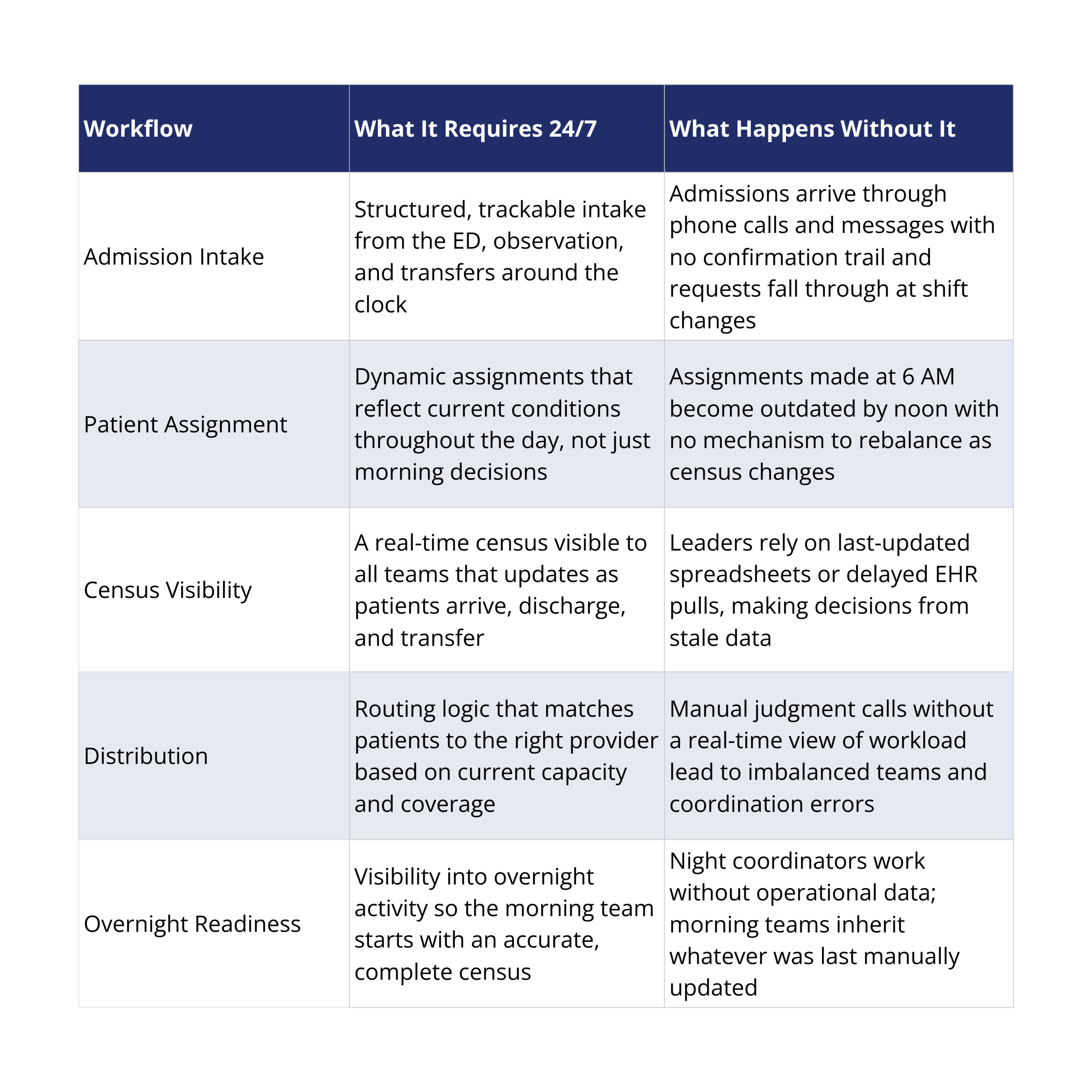
Where Do Most Programs Lose Visibility?
The breakdown doesn’t usually happen at once. It accumulates.
A request comes in through a phone call instead of the intake queue, so the coordinator notes it manually and the shift change happens before it gets confirmed. By 8 AM, the morning team is starting assignments from a census that’s missing two patients.
The issues that surface in the morning, like misassigned patients, unequal workloads, and unexpected census sizes, likely began the night before. They’re the downstream effect of a 14-hour window where no system kept track.
That’s the gap that a 24/7 operations platform closes.
What Does a Day Actually Look Like in a Connected Hospital Medicine Program?
When hospital medicine workflows are connected into a single operating system, the pattern changes across every shift:
Morning (5–10 AM)
The morning team logs in to a census that’s already current. Overnight admissions are accounted for. New admits from the ED are in the queue with their intake details. Assignments are built from a real picture of patient volume and provider availability.
Midday (10 AM–3 PM)
New admissions come in throughout the afternoon. Each request is captured automatically as it arrives from the ED, transfers, and observation. The coordinator can see what’s pending, what’s been assigned, and what needs attention, all in one view. Assignments adjust as workloads shift.
Evening and Overnight (3 PM–7 AM)
The night team picks up from a current, accurate census. Intake continues to run. Distribution logic routes new patients to the right provider without someone manually tracking who’s on call. Leaders can see census trends and staffing needs without calling anyone.
This isn’t a vision of a future hospital. It’s what coordinated HM operations look like when the tools match the pace of the work.
Watch: From Fragmented Workflows to Coordinated Operations in Hospital Medicine
A 30-minute recorded webinar with a live preview of medaptus Command’s Intake module and Coordinator Dashboard.
How Does medaptus Command Support 24/7 Hospital Medicine Operations?
Medaptus Command is the hospital medicine operations platform built for continuous operations. It connects five core modules — Intake, Assign, Distribution, Reconciliation, and Analytics — into a single, coordinated system that runs 24/7 alongside your EHR.
Instead of managing morning assignments and then losing visibility for the rest of the day, hospital medicine programs can run as a coordinated operation from the first admission to the last discharge.
Learn more about medaptus Command →
Conclusion
The morning rounding list is not the hardest part of hospital medicine operations. The hardest part is everything that happens after.
Building for that reality means having a system that doesn’t stop when morning rounds do. Real-time intake tracking. Dynamic assignment. Continuous census visibility. And the operational foundation to make decisions at any hour, not just when the data happens to be fresh.
That’s what 24/7 operations looks like. And it’s what your hospital medicine program deserves.
Frequently Asked Questions About 24/7 Hospital Medicine Operations
What does 24/7 hospital medicine operations mean?
It means all core hospital medicine workflows — admission intake, patient assignment, census management, distribution, and reconciliation — operate continuously and in real time, not just during the morning window. A 24/7 model ensures admissions are tracked, assignments are updated, and visibility is maintained across every shift.
Why do most hospital medicine programs lose visibility after morning rounds?
Most hospital medicine tools were built to support morning assignments, not continuous operations. After rounds, programs typically rely on phone calls, spreadsheets, and manual coordination to manage new admissions and census changes — creating gaps that accumulate throughout the day and into overnight.
Can hospital medicine run continuously without adding staff?
Yes. 24/7 operations is about systems, not headcount. When intake, assignment, and census are connected in a single platform, the coordination burden that currently falls on people is handled by the system without requiring additional staff to manually track or reconcile.
What is a hospital medicine operations platform?
A hospital medicine operations platform is software that connects core hospital medicine workflows into a single, continuously operating system. It coordinates admission intake, patient assignment, distribution, census reconciliation, and analytics in real time, giving hospital medicine leaders visibility and control across all shifts.
How does medaptus Command enable 24/7 hospital medicine operations?
Medaptus Command connects Intake, Assign, Distribution, Reconciliation, and Analytics into a single platform that runs alongside your EHR. It provides a real-time view of admissions, assignments, and census, from the first admit of the morning to the last handoff of the night. Learn more at medaptus.com/medaptus-command.

About The Author
Jaclyn Corbett is the Product Manager for medaptus Command and Assign, with over 13 years working at the intersection of healthcare operations and software development. She works directly with hospital medicine programs to understand how operational workflows break down and how technology can reconnect them.
Get the latest updates and news delivered to your inbox.
Subscribe to our newsletter today.