

Blog Summary
Epic is one of the most widely implemented EHR platforms in the country, and for good reason. It centralizes patient data, documentation, and ordering in a way that genuinely changes how hospitals operate. But hospital medicine programs running on Epic still report spending 1-3 hours every morning manually building rounding lists, still coordinate coverage changes by phone and text, and still lose visibility into their census the moment rounds begin. This blog explains why that happens and what it means for programs evaluating whether additional tools are needed on top of Epic.
One of the most common questions I hear in sales conversations is some version of this: we’re already on Epic, so why do we need something else?
It is a completely fair question, and I want to answer it directly.
Epic was never designed to serve as the operational layer that sits on top of the EHR: the daily workflow of figuring out who owns which patients, building the rounding list, keeping it current as the day unfolds, managing admissions and coverage transitions in real time. It is difficult for a hospital medicine program to operate without this kind of specialization.
Is Epic Designed to Handle Hospital Medicine Rounding Assignments?
Not really. Epic is a documentation and data platform. It records what happened, supports clinical decision-making, and connects information across your health system. It is excellent at that.
Rounding assignment is an operational coordination problem, not a documentation problem. Someone has to look at the census, cross-reference the provider schedule, apply continuity logic, balance workload, account for geography, and then get a finalized list in front of the right people before rounds begin. Epic has the underlying data for all of that. It does not have the workflow tools to do anything with it automatically.
What most programs do is export that data from Epic and then do the coordination work manually, in a spreadsheet, in a shared document, or on a whiteboard. Which means that going live on Epic did not change that part of the workflow at all.
What About Epic’s Patient List Tools? Don’t Those Help With Rounding Assignments?
Epic’s patient list tools help with visibility, not with assignment. You can build lists in Epic, and those lists are useful for documentation purposes. But building an automatically balanced, continuity-aware, geography-optimized rounding list across a hospital medicine team, one that updates dynamically and syncs back to the EHR, is not what those tools are for.
The distinction matters because a lot of programs have gone live on Epic expecting the assignment problem to get better and then been surprised when it did not. The census is there. The data is there. But nothing in Epic is making decisions about which provider should cover which patient based on prior assignment history, floor proximity, handoff timing, and patient complexity. That logic has to live somewhere.
How Does Medaptus Work With Epic?
We integrate with it, in multiple ways.
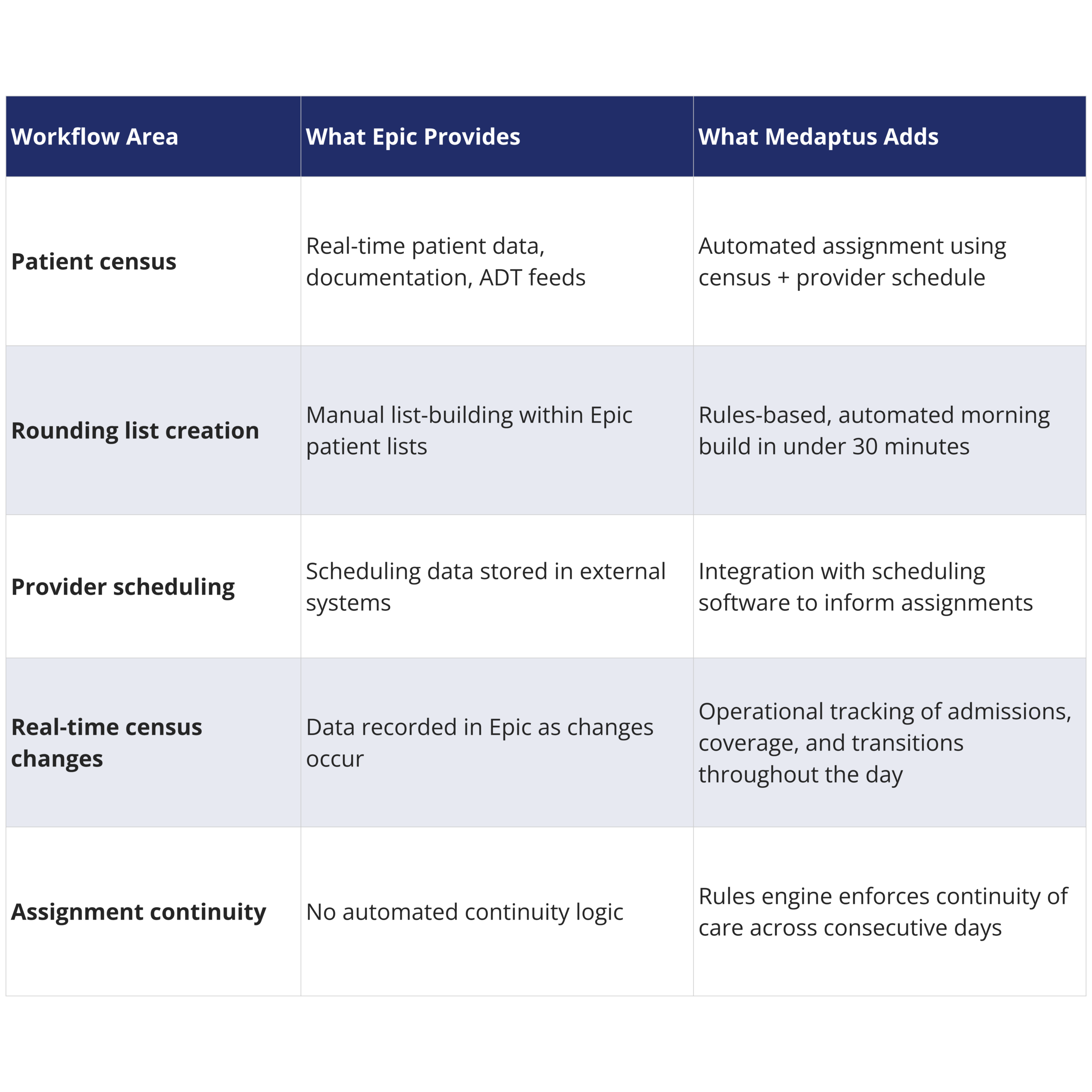
Medaptus Assign pulls the patient census directly from Epic and the provider schedule from your scheduling software, runs the rules-based assignment logic your team defines, and syncs the finalized assignments back to Epic so providers see their patient lists in the system they are already using. Command runs alongside that, maintaining real-time visibility into admissions, coverage of transitions, and census changes throughout the day, in conjunction with Epic, not instead of it. Because of this, implementing medaptus products with Epic is seamless for our customers.
The frame that makes the most sense is this: Epic gives you the data. Medaptus gives you the operational workflow on top of that data.
A lot of programs we work with are fully committed to Epic. They are not looking to replace it or work around it. They are looking for what comes next, the tools that make their team’s daily operations actually work the way they expected them to when they signed on for the implementation.
Conclusion
Going live on Epic was likely the right call for your program. It was not, and was not supposed to be, the end of the work. The data infrastructure is there. What hospital medicine programs are still figuring out, at most organizations I talk to, is the operational coordination layer that sits on top of that data.
That is the problem medaptus was built to solve and we work with Epic data (or any EHR’s data) to help your organization achieve better workflows. If you are on Epic and your morning assignment process still feels like it did before your implementation, that is worth a conversation.
Learn more about medaptus Command
Learn more about our Epic integrations
FAQs
Does medaptus work with Epic?
Yes. Medaptus Assign and Command integrate directly with Epic, pulling census data and syncing finalized assignments back to the EHR so providers see their patient lists in the system they already use.
Why doesn’t Epic handle rounding assignment automatically?
Epic is built for documentation, data management, and clinical workflows. Rounding assignment is an operational coordination problem that requires cross-referencing census data, provider schedules, and continuity logic, and that is the workflow gap medaptus is designed to fill.
What does medaptus add on top of Epic?
Assign automates the morning rounding list build using rules your team defines. Command maintains real-time operational visibility throughout the day, tracking new admissions, coverage transitions, and census changes without requiring manual updates.
Can we keep using Epic after implementing medaptus?
Yes, and you should. Medaptus is designed to integrate with Epic, not replace it. The finalized assignments sync back to Epic, so your clinical workflows stay in the EHR.
We went live on Epic and our assignment process didn’t improve. Is that normal?
It is more common than most programs expect. Epic improved your documentation and data infrastructure, but the rounding assignment workflow operates at an operational coordination layer that Epic was not designed to automate. That is the specific gap medaptus addresses.

About The Author
Jaclyn Corbett is the Product Manager for medaptus Command and Assign, with over 13 years working at the intersection of healthcare operations and software development. She works directly with hospital medicine programs to understand how operational workflows break down and how technology can reconnect them.
Get the latest updates and news delivered to your inbox.
Subscribe to our newsletter today.