
Blog Summary
Manual hospital medicine workflows hurt patient flow by relying on disconnected tools like phone calls, whiteboards, spreadsheets, and manual handoffs to communicate critical patient information. Because admissions, bed status, provider assignments, and discharge updates aren’t shared in real time, delays compound across the hospital, increasing length of stay, slowing discharges, raising operational costs, and contributing to patient safety risks. A coordinated, real-time operational workflow gives hospital medicine, nursing, and bed management teams shared visibility into patient movement, helping patients move through the hospital more efficiently without replacing the existing EHR.
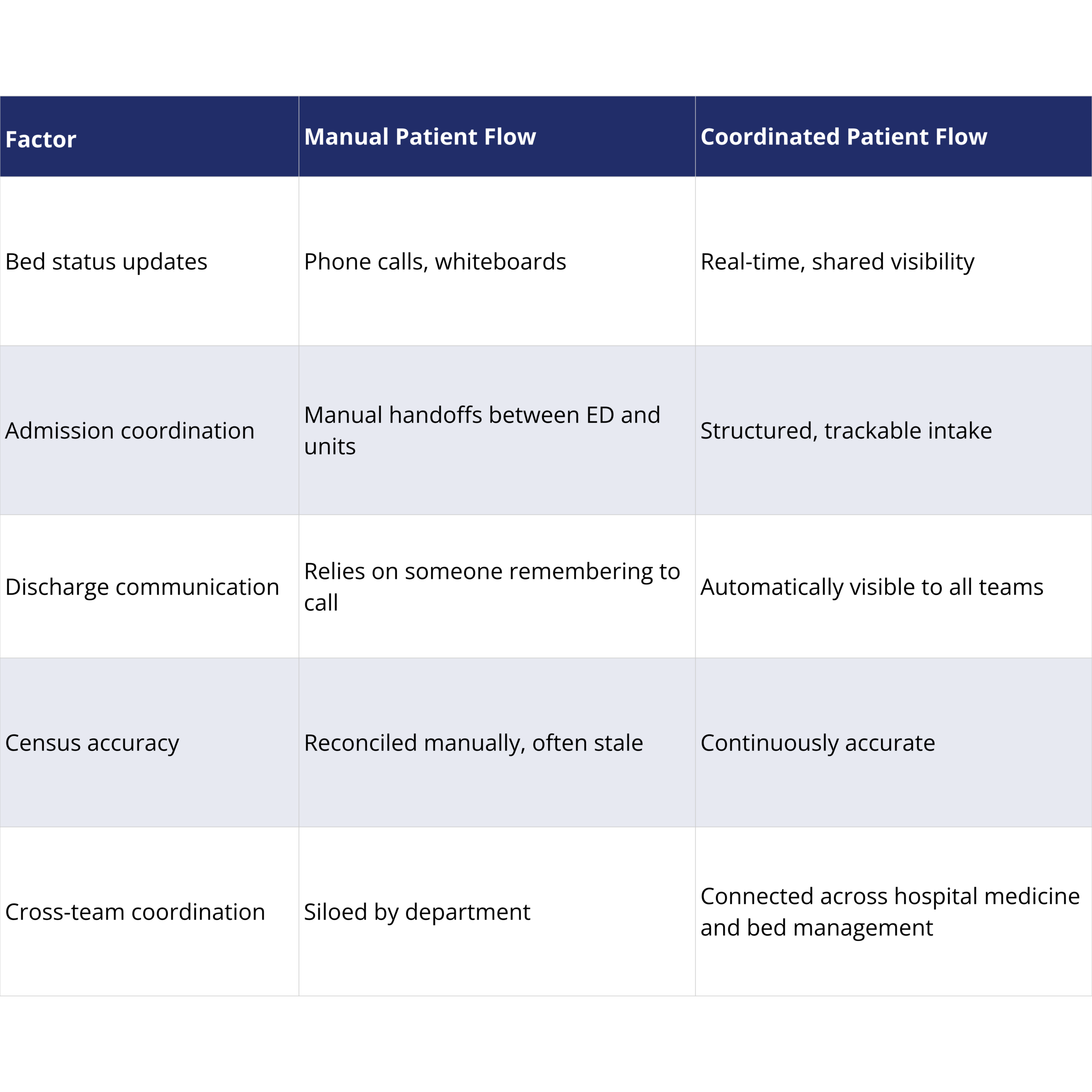
I’ve walked into a lot of hospital medicine departments over the years, and the pattern is almost always the same. There’s a whiteboard somewhere with today’s census scratched out in dry erase marker, a charge nurse making the same three phone calls every morning to figure out which beds are actually open, and a hospitalist team piecing together their assignments from whatever combination of spreadsheet and sticky note got them through yesterday.
None of this is because the team isn’t good at their job, it’s because patient flow depends on information moving in real time. Most of the tools supporting hospital medicine were never built for that. This article walks through why that gap shows up as slower discharges and longer stays, what the data says it actually costs, and what teams can do about it without ripping out the systems they already rely on.
Why Does Patient Flow Break Down When Hospital Medicine Workflows Are Manual?
Patient flow depends on a dozen small handoffs happening correctly and on time: a bed getting marked clean, a discharge order getting communicated to the right people, a rounding list reflecting who got admitted overnight. When those handoffs run through phone calls and whiteboards instead of a connected system, delay is built into the process by default. The Institute for Healthcare Improvement (IHI) white paper on hospital-wide patient flow found that each delayed patient transfer adds an average of 2.6 additional days to a stay and $3,335 in additional cost. That isn’t because anyone made a bad clinical decision, it’s because the operational information needed to move that patient wasn’t available to the right person at the right time.
What Does the Data Say About Boarding, Delays, and Length of Stay?
The numbers here are worth sitting with. That same IHI research found patients who experienced delayed transfers had a 53% increase in mortality risk compared to patients who were transferred without delay, which tells you this isn’t just an efficiency problem, it’s a patient safety one.
The American Hospital Association’s issue brief on discharge delays found average length of stay increased 19.2% compared to pre-pandemic levels across the board. For patients being discharged to post-acute care specifically, that number climbed closer to 24%. When your bed management and hospital medicine teams don’t have a shared, real-time view of who’s ready to move and where they’re going, those delays compound across every unit in the building.
How Can Hospital Medicine Teams Fix Patient Flow Without Overhauling Their EHR?
The good news is that fixing this doesn’t mean replacing your EHR or asking clinicians to learn an entirely new system. The solution is adding a coordination layer that sits alongside what you already have and gives everyone the same real-time view of admissions, assignments, and census. That’s the gap medaptus Command was built to close, connecting intake, assignment, distribution, and reconciliation into one continuously updated system instead of a set of disconnected workarounds. Here’s a short look at what that coordination looks like in practice:
Watch: From Fragmented Workflows to Coordinated Operations in Hospital Medicine
Conclusion
Manual hospital medicine workflows don’t fail because teams aren’t working hard enough, they fail because patient flow needs real-time information that whiteboards and phone calls can’t deliver consistently. The data backs up what most bed management and hospital medicine leaders already feel every day. They are struggling with delayed transfers that cost time, money, and in some cases, patient safety. Coordinating that information into a single, real-time system is how hospital medicine teams close that gap, and we’re happy to show you what that looks like for your program.
Book a demo of medaptus Command here.
FAQs
What is patient flow in a hospital medicine context?
Patient flow refers to how patients move through the hospital, from admission to assignment to discharge. How efficiently that movement happens depends on how well information travels between the teams involved.
Why do manual processes slow down patient flow specifically?
Manual processes like phone calls and whiteboards depend on someone remembering to communicate a status change. This introduces delay and error compared to a system where that information updates automatically and is visible to everyone who needs it.
Does fixing patient flow require replacing our EHR?
No. A coordination layer like medaptus Command works alongside your existing EHR, extending it with real-time visibility rather than replacing the clinical documentation system you already use.
Who is responsible for patient flow, hospital medicine or bed management?
Both. Patient flow breaks down specifically because it depends on hospital medicine, bed management, and nursing leadership all working from the same information. That’s why a shared system matters more than any single team’s process.
How is patient flow connected to patient safety?
Delayed transfers have been directly linked to increased mortality risk in published research. The Institue for Healthcare Improvement found patients who experienced delayed transfers had a 53% increase in mortality risk compared to patients who were transferred without delay, which tells you this isn’t just an efficiency problem, it’s a patient safety one.

About The Author
Jaclyn Corbett is the Product Manager for medaptus Command and Assign, with over 13 years working at the intersection of healthcare operations and software development. She works directly with hospital medicine programs to understand how operational workflows break down and how technology can reconnect them.
Get the latest updates and news delivered to your inbox.
Subscribe to our newsletter today.